Maintenance software
Three different things are sold under that name: the CMMS, born in the factory; the fault-reporting tool, built so that anyone on the team can say what broke; and the services platform, for those who maintain many buildings. Choosing well means knowing which of the three your premises need. Here are the three, six questions for the demo and the page for each sector.
What maintenance software is
It is the program that replaces the notebook, the spreadsheet and the WhatsApp group in three jobs: logging each fault with its time, assigning it to whoever fixes it and warning about inspections that repeat. The fullest ones add the equipment inventory, spare parts and what each repair costs. It is also called a CMMS (computerised maintenance management system); in Spain, GMAO.
The difference between products is not in the feature list, which looks much the same. It is in who they were written for: a maintenance manager with in-house technicians, or a business where a waiter sees the fault and an outside company fixes it.
The three kinds of maintenance software
| Kind | Who it was built for | What it holds | What it asks of whoever reports |
|---|---|---|---|
| CMMS | Factories, hospitals and buildings with a maintenance department and in-house technicians | Equipment inventory, work orders, planned maintenance, spare parts, hours and costs | An account in the product, its app or a request portal |
| Fault-reporting tool | Businesses with premises where anyone on the team reports and a technician or supplier fixes | The report with a photo, whose job it is, where it stands and when it was closed; reminders of inspections | As little as possible: a message, a short form or a QR code |
| Services platform (facility management) | Companies that maintain many buildings, their own or their clients' | Contracts, approved suppliers, quotes, spaces and maintenance across the whole portfolio | A portal per client or per building |
The names get mixed on vendors' websites: many fault-reporting tools are advertised as a CMMS, and many CMMS have a request portal.
A 60-room hotel, a restaurant, a gym or a chain of shops usually sit in the second row, even when they search for a CMMS. An industrial unit with twenty machines and its own workshop is in the first. Whoever manages thirty office buildings, in the third.
Six questions before choosing
Take them to the demo and ask for answers with a case of yours, not a sample screen:
- Who will report? If it is floor, housekeeping or shop staff, count the steps the product asks for. What cannot be done one-handed in ten seconds gets left for later, and later never comes.
- Who fixes it? With in-house technicians, an app for them makes sense. With outside suppliers, ask whether they must sign up or install anything to receive the job.
- What happens with urgent faults? The cold room that stops cooling at eleven at night. Ask who it rings, at what time and what happens if nobody answers.
- How does the person who reported find out? If they cannot see where their fault stands, they ask again, and the manager ends up answering the same thing five times.
- Do you need inventory and costs? If you want to know what each piece of equipment cost over the year, you need a CMMS. If what gets lost is the reports, you do not.
- Which inspections does the law require? Fire extinguishers, air conditioning, low voltage, legionella, lifts. Which apply to you, in regulations by sector, and their dates, in the mandatory inspections calendar.
Planned and reactive maintenance software
Almost every product says it handles both, and the two ask for different things. Reactive maintenance starts when something fails: it comes unannounced, at any hour and from anyone. What it needs is an easy way in and a report that never goes ownerless. Planned maintenance has a date and is run by one person with a calendar: what it needs is for the date not to slip and a record that it was done.
| Reactive | Planned | |
|---|---|---|
| Who starts it | Anyone on the team, on seeing the fault | The person in charge, with the calendar |
| What fails most | The report gets lost or nobody knows whether someone took it | The date slips or the paperwork is not kept |
| What the software must do | Take the report where the team already writes, assign it and chase it | Warn before it is due and record that it was done |
| Where the law rules | No legal deadlines; the business sets them | To a large extent: fire, air conditioning, electricity, legionella |
If you run it in a spreadsheet today, the comparison between staying and switching is in CMMS or Excel.
Maintenance software for each sector
Each sector has its own faults, suppliers and inspections. These pages hold the criteria for each one and the products that come up when you search for it, described with what their own websites say:
- Maintenance software for hotels: what housekeeping finds in the room, before the next arrival. And of all the AI offered to a hotel, which is which, in AI for hotels.
- Maintenance software for restaurants: the cold room, the hood and the dishwasher, with outside technicians.
- Building maintenance software: offices, residents' associations and multi-tenant buildings.
- Maintenance software for shops: the shutter and the air conditioning, shop by shop.
- Maintenance software for gyms: machines, changing rooms and the pool.
- Maintenance software for clinics: the room and the equipment, with no patient data.
- Maintenance software for schools: what the caretaker sees before anyone else.
- Maintenance software for industrial units and warehouses: the stopped machine and the loading bay.
- Maintenance software for offices: the air conditioning, the meeting rooms and what belongs to the building.
- Maintenance software for coworking spaces: what a member tells whoever runs the space.
- Maintenance software for franchises: site by site, with the franchisee in the middle.
- Maintenance software for sports centres: pool, changing rooms and courts.
- Maintenance software for academies: classrooms, projectors and heating.
- Maintenance software for veterinary practices: hospitalisation, theatre and autoclave.
- Fault reporting software for residents' associations: the lift, the entrance and the garage.
If you want a CMMS with no sector in mind, the best known are in best CMMS. If it is a reporting tool, in incident management software and incident management app.
Where Bedel fits, and what it does not do
Bedel is a fault-reporting tool: the second kind in the table. It is not a CMMS. Whoever sees the fault sends it to the business's WhatsApp number as a text, a photo or a voice note. Bedel turns it into a ticket with a number and a time, sends it to the right technician or supplier, who receives it on their own WhatsApp without installing anything, and tells the person who reported it about each step. If it is marked urgent, it rings the on-call phone at any hour; if the deadline passes, it goes up to whoever is above. Dated inspections arrive as a monthly reminder to whoever runs maintenance. Everything comes out in an Excel file. How it works in each kind of premises, in incident management on WhatsApp.
What it does not do:
- It holds no equipment inventory or asset records.
- It makes no work orders with materials, hours or costs.
- It does not store inspection certificates, which stay in your folder.
- It does not put several premises on one screen: each site is one account, with its own number.
- It does not connect to other software: what comes out of Bedel is its Excel file.
If you need what is on that list, a CMMS is for you, and Bedel can be the way in for the reports that never reach the CMMS.
Frequently asked questions
What is maintenance software?
A program that logs faults, assigns them to whoever fixes them and reminds you of dated inspections. The fullest ones, CMMS, also hold the equipment inventory, spare parts and costs.
What is the difference between maintenance software and a CMMS?
CMMS is the technical name for the fullest kind of maintenance software, the one born in industry. Not all maintenance software is a CMMS: a fault-reporting tool collects and hands out faults without inventory or costs, and for many premises that is enough.
What is the best maintenance software for a small business?
The one your team will really use. In a business with premises what weighs most is that reporting is immediate and that the outside supplier gets the job without signing up. Try it in the demo with a real fault from last week.
Does maintenance software handle both planned and reactive work?
Almost all say so. Look at how: reactive work needs an easy way in for anyone on the team; planned work needs a calendar that warns before each inspection is due and records that it was done.
Can maintenance be run on WhatsApp?
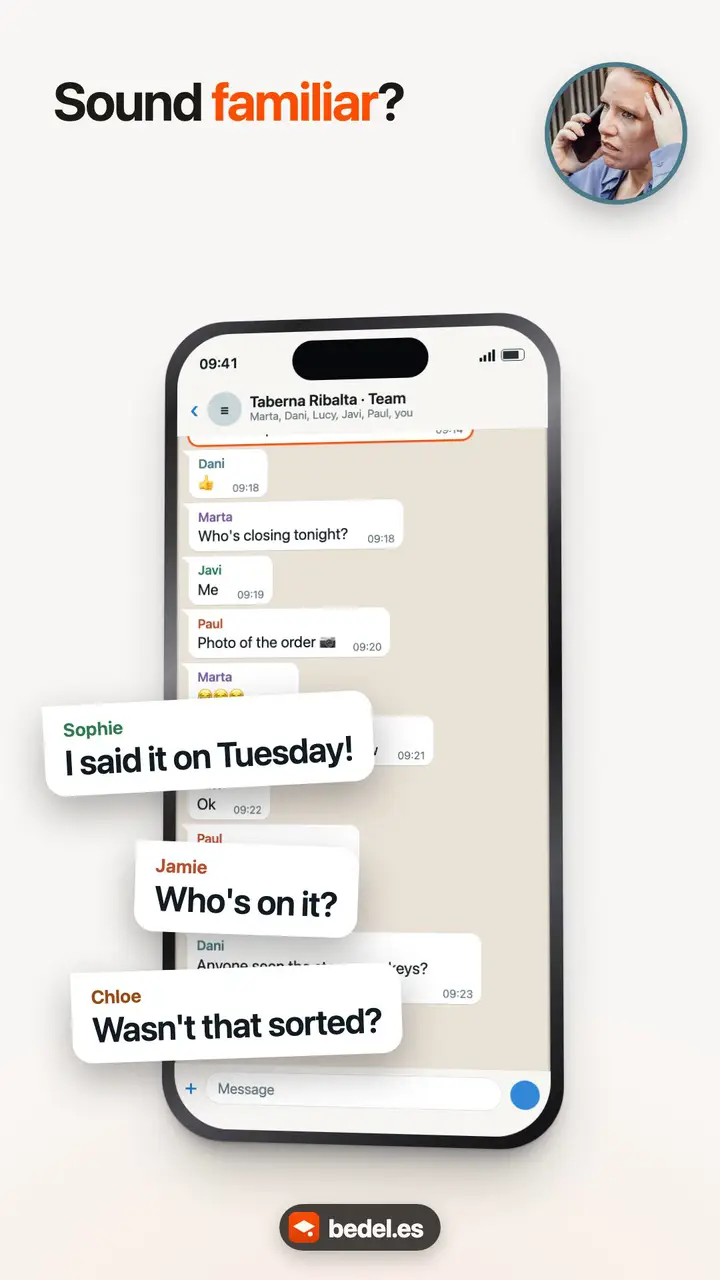
The way in for reports and the message to the technician, yes, as long as behind the number there is something that turns each message into a ticket and follows it. A plain WhatsApp group does not work: the fault gets mixed with everything else and nobody knows whether someone took it.
Is Bedel maintenance software?
It is a fault-reporting tool on WhatsApp with inspection reminders. It is not a CMMS: no inventory, spare parts or costs, and each site is one account.
Comparisons
- CMMS: what it is and which one fits your premisesWhat a CMMS is, what a team really needs from maintenance, how corrective and preventive differ, and when WhatsApp is enough and when you need dedicated software.
- Automatic incident handling on WhatsAppWhich part of an incident can be answered and moved on its own over WhatsApp, what a person still does, and how it differs from an auto-reply or a chatbot.
- WhatsApp for hotels: guest customer serviceThe four types of WhatsApp software for a hotel, what each one solves, and why guest service usually fails after the conversation: when what the guest asked for has to be fixed.
- Maintenance software for hotels in Spain, 2026Six criteria built for a hotel, ten products described with what their websites say, and where Bedel fits, which is not one of them.
- Maintenance software for restaurants, 2026Six criteria built for a kitchen, nine products described with what their websites say, and where Bedel fits, which is not one of them.
- Maintenance software for buildings in Spain, 2026Six criteria built for a building, ten products described with what their websites say, from CMMS to block management, and where Bedel fits.
- Incident management software in Spain, 2026Six criteria so you don't buy a help desk when what gets lost is faults, eight products described with their own websites, and where Bedel fits.
- Incident management app in Spain, 2026Eight incident apps described with their own websites, six criteria to choose, and the question almost nobody asks: who has to install it.
- Gym maintenance software in Spain, 2026Six criteria built for a gym, seven products described with what their websites say, from CMMS to membership software, and where Bedel fits.
- Clinic maintenance software in Spain, 2026For clinics and clinic groups, not hospitals: six criteria, seven products described with what their websites say and where Bedel fits.
- Store maintenance software in Spain, 2026For a shop or a store network: six criteria, five products described with what their websites say and where Bedel fits.
- School maintenance software in Spain, 2026For state and private schools: six criteria, seven products described with what their websites say and where Bedel fits.
- Warehouse maintenance software in Spain, 2026For factories, warehouses and logistics sites: what to check, six CMMS summarised from their websites and the gap left by reporting from the workstation.
- Preventive maintenance software: how to chooseWhat a preventive plan holds, the three kinds of recurring task on a site, how a CMMS handles them and how a reminder tool does, and when each is needed.
- Corrective maintenance software: what to ask of itThe journey of an unplanned fault in five moments, what goes wrong at each without software, how urgency, deadline and escalation are set up, and which times are worth measuring.
- Work order management: full order or simple ticketWhat a work order is and where it comes from, what a full system holds, how it differs from a fault ticket and the signs that a business with premises needs one or the other.
- Fault management software: how to choose oneThe path of a fault from whoever reports it to whoever repairs it: the reporting channels and what each one loses, sorting by trade, the outside supplier, the photo and the status sent back.
- Maintenance app: who actually opens itThe four phones a fault passes through, what an app asks of each, why it is dropped where staff turn over, seven demo questions and the no-app alternative.
- Maintenance request software: intake channelsThe six channels a maintenance request comes in through, the four details it needs, who sorts it and how the person who made it gets an answer.
- CMMS with WhatsApp: add-on alert or the way inThe two things sold as a CMMS with WhatsApp (an added notification or the entry point), five questions to tell them apart and who each one suits.
- CMMS for small business: what you need and don'tWhat a small business with premises asks of maintenance, what it can leave out of a full CMMS, a yes-or-no test to see if you need one and five steps to start.
- CMMS software: what it is and who needs all of itWhat CMMS software is, why it is the same thing as a GMAO, what each part is called by country, what it holds and which businesses need all of it or only the report.
- Facility management software: what it coversThe areas of a facility management suite, which ones weigh on a small or mid-size company's facilities team day to day, and the only one Bedel covers.
- Mandatory inspections software for premisesThe inspections Spanish law dates for premises, who carries them out, what is left to the owner and how far a program and a WhatsApp reminder can go.
- Maintenance software for offices: what to checkWhat breaks in an office, whose job each repair is between tenant, landlord and supplier, what to demand of a product and the part Bedel does.
- Residents' association fault reporting softwareFaults in the common areas, who reports them, which trade fixes them, what the managing agent needs to know about each one and the part Bedel covers.
- Maintenance software for coworking spaces: a guideA coworking space's faults seen from the operator's side: who reports them, whose they are, what to ask in a demo, when a CMMS is worth it and Bedel's part.
- Maintenance software for franchises: site by siteMaintenance in a franchise network, with its two owners: what falls to the franchisee, what head office watches, what to ask in a demo and the part Bedel does.
- Maintenance software for sports centres and poolsSports centres, clubs and pools: what fails in the water, the changing rooms and the courts, which checks the rules ask for, when a CMMS suits and what Bedel does.
- Maintenance software for academies: what to askWhat breaks in a language school, a tuition centre or a training centre, who sees it between lessons, when a CMMS is too much and the part Bedel covers.
- Maintenance software for veterinary practicesThe faults of a veterinary practice or hospital: kennels and climate, theatre, autoclave and X-ray, each with its official service; questions for the demo and Bedel's role.
- AI for hotels: what to buy, bookings to repairsA buyer's guide: the four areas of a hotel where AI works today, who decides in each, the questions for the demo and the stretch Bedel covers.
- WhatsApp at work in Spain: group or incident managerWhatsApp groups at work in Spain: what the AEPD has ruled, what the right to disconnect adds and how a group compares with an incident manager for faults on business premises.
- CMMS or Excel for maintaining business premisesWhen a spreadsheet is enough and when a CMMS is needed, how to build the preventive plan in Excel and which records the law says to keep.
- Best CMMS for businesses with premises: criteriaSix criteria built for premises, seven CMMS described with what their websites say, and where Bedel fits, which is not one of them.
Rules by sector
- Restaurants and barsThe obligations of a restaurant or a bar in Spain: what is specific to the kitchen and the checks on the premises, each with the condition that triggers it, how often it applies and its article.
- GymsA gym: no national law; qualifications, insurance and notices under each region's sports professions act, plus low voltage, Legionella, pool, RIPCI and defibrillator as premises.
- HotelsA hotel: guest register and reporting within 24 hours, regional classification, low voltage and lift as a public-assembly venue, RIPCI, Legionella, pool, kitchen and defibrillator.
- Residents' associationsThe obligations of a Spanish residents' association: upkeep, reserve fund, owners' meeting and administrator under the Horizontal Property Act, building logbook, building inspection and the checks on each communal installation.
- Shops and franchisesA shop: responsible declaration up to 750 m², opening hours, prices, franchises with no register since 2018, complaint forms, accessibility adjustments and the inspections of premises open to the public.
- OfficesThe obligations of an office in Spain: temperature and upkeep of the premises, screen work, health and safety, coordination with contractors, internal reporting channel, right to disconnect and building checks.
- SchoolsA school: minimum facilities, protocols against violence and a wellbeing coordinator, canteen and menus from April 2026, self-protection and the building inspections.
- Industrial unitsAn industrial unit: fire inspection every five years under the 2025 regulation, chemical storage (APQ), air receivers, work equipment, low voltage, cooling towers and self-protection.