Maintenance app
On paper everyone uses it; in a business with premises only the technician ends up opening it, and sometimes not even him. Before choosing one, count how many phones would have to carry it: that of the person who sees the fault, the in-house technician's, the outside supplier's and the manager's. This page goes through what an app asks of each, why it falls out of use where staff change, and what happens when there is none and everything runs through the WhatsApp they already have. Bedel, which publishes this page, belongs to that second group: there is nothing to install.
What a maintenance app is
People also search for it as “maintenance management app” or “maintenance application”, and it is nearly always the mobile side of something bigger: maintenance software or a CMMS that lives on the office computer and puts three screens on the phone. The first is for reporting: pick the area, write what is wrong and attach a picture. The second is the technician's job list, with what is pending that day. The third is the close-out: mark it finished, note what was replaced and, in some, sign with a finger.
Those three screens take for granted something that is true in a factory and not in a bar: that everyone involved has the application downloaded, an account open and the habit of looking at it. The useful question is not what the app does, but how many pockets it will actually be in.
Who has to open it: four different phones
A fault passes through four pairs of hands. The app asks something of each, and each has its own reason not to do it.
| Who | What an app asks of them | What happens with no app |
|---|---|---|
| Whoever sees the fault (the waiter, the gym-floor instructor, the person on the till) | Download it on a personal phone, create a user, remember the password and find the “new report” button mid-shift | They message the site's number as they would any contact: a photo of the dripping tap or a ten-second voice note |
| The in-house technician | Keep it open all day and update the status of every job; he gets the most out of it | The report lands in his WhatsApp with the picture and he answers with a button: today, tomorrow or “I need more detail” |
| The outside supplier (the refrigeration engineer, the locksmith, the lift company) | Install each customer's application, or have someone on site ring him and then log what he did on his behalf | He gets the job on the WhatsApp he already uses with customers, with no sign-up, and replies there when finished |
| The manager | Check the dashboard, chase whoever has not updated and key in the reports that arrived some other way | Opens the web panel when it suits; if a deadline runs out, the report comes up to them without anyone having to keep watch |
The right-hand column describes how a WhatsApp fault-reporting tool such as Bedel works; not every app-less tool behaves the same way.
The in-house technician is the only one of the four for whom the app is his tool. The other three experience it as one more chore. That is why so many roll-outs end with a technician who logs everything himself: he takes the call, opens the application and creates the report in the caller's name.
Why apps are abandoned where staff turn over
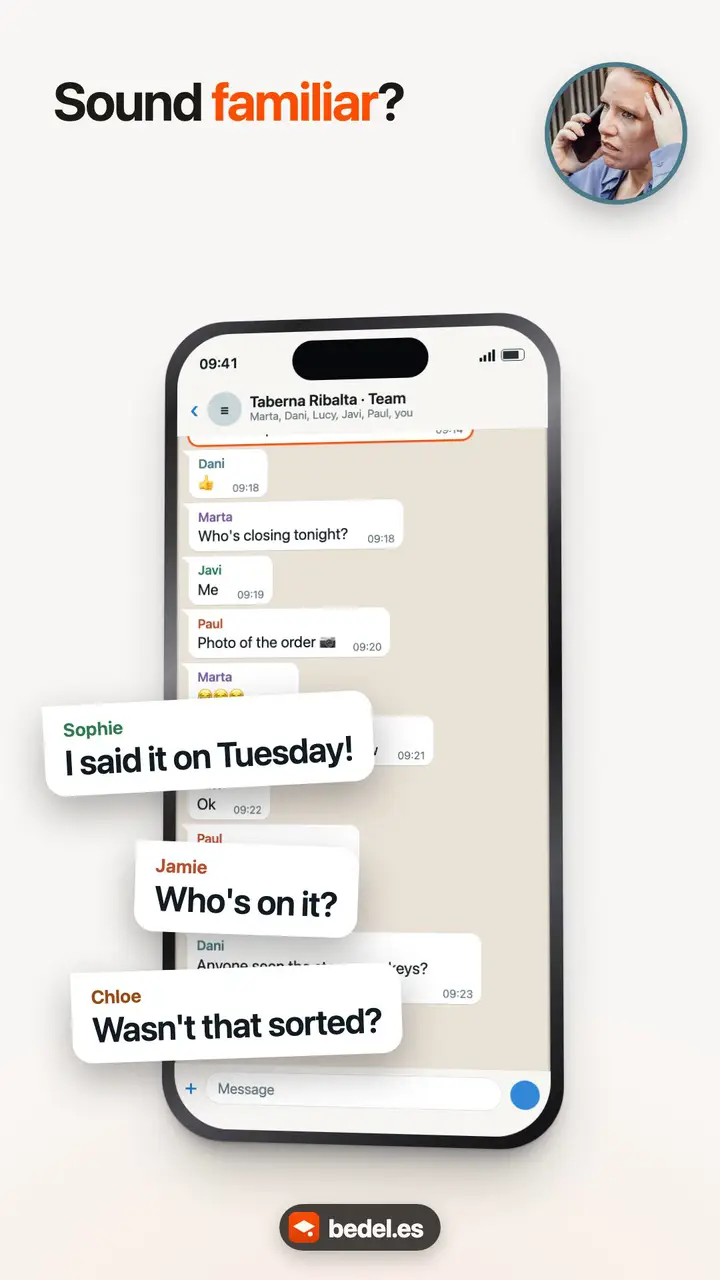
In hospitality, retail or sport, people come and go. A restaurant with twenty people on the payroll may have registered twice that number by the end of the year, between extras, cover and high season. Every newcomer is an install, an account and an explanation. What tends to happen:
- The phone is theirs. Asking an employee to put a work application on their private phone does not always go down well: many have neither the storage nor the inclination.
- The password is forgotten. Someone who reports a problem every three weeks does not remember their login on the day they need it, and resetting it takes longer than telling the manager.
- Saturday's extra does not exist for the app. They work two nights, see the coffee machine leaking and have no way to say so. They mention it out loud, and out loud is where it stays.
- There is no signal in the basement. The cold room, the boiler room and the store are exactly where faults turn up and where an application loads worst.
- The supplier has thirty customers. If each one asks for its own app, he installs none. He works by phone and by message, and the end of the job goes unrecorded.
- Nobody removes the people who leave. Their user stays active until someone happens to notice.
The sign that an app has fallen out of use shows early: within a few months the reports are back in the WhatsApp group or in “when you get a minute”, and the application only holds the ones the technician entered himself. What is lost with the group, and what the data protection authority has said about it, is in WhatsApp group or incident manager.
When an app is the right tool
It is not all turnover. There are teams where the application earns its place on the phone:
- An in-house maintenance team that starts the morning with a route and ticks it off.
- Jobs that need a point-by-point checklist, such as the weekly round of a swimming pool or a boiler room.
- Technicians who point the camera at the label on a machine to open its record and see what was done last time.
- Job sheets the customer signs on screen, as a maintenance contractor does when working on someone else's site.
- Areas with no signal where the work has to carry on offline and sync on the way out.
If you recognise yourselves in that list, what you want is the app of a CMMS. How that work is organised is in work order management and preventive maintenance software; the products, in best CMMS. It is the norm in industrial units and warehouses with their own workshop.
Seven questions for an app demo
Ask for answers with the phone in hand, not on slides:
- How many taps from the home screen to sending a report with a photo? Count them out loud. Beyond five, the night shift will not get to the end.
- Does the person reporting need a user? And if so, who creates it, how long it takes and what you do about the temp who comes for one weekend.
- What does the outside supplier receive? An email, a link or a notification from an app he does not have. Ask how he confirms he has finished.
- Does it work with no signal? Try it there and then, in flight mode.
- What does the person who reported see? Whether they can follow their report without logging in anywhere or have to go and ask.
- Who finds out if nobody responds? An unread report at midnight on a Friday is the real exam.
- What happens when someone leaves the company? How access is withdrawn and whose name their open reports end up under.
The same questions work for reporting applications that are not about maintenance; several of them, described with what their own websites say, are in incident management app.
The alternative: no app and the WhatsApp you already have
There is another way to deal with those four phones: ask nobody to install anything. The business has a WhatsApp number for faults; whoever sees one writes it there, and a system behind the number does the work the application would do. That is how Bedel works, so it is worth saying plainly: Bedel is not a maintenance app. It is not in the app stores and there is nothing to download.
What there is, is this. The people the site has put on its list write to the number: a few lines, a photo on its own or a voice note. Bedel opens a ticket with a number and a time, and if it is not clear where the problem is, it asks. The ticket goes to the technician or supplier it belongs to, who sees it on their own WhatsApp. When someone accepts it and when it is closed, the person who reported gets a message. What the site has flagged as urgent rings the on-call phone even at three in the morning, and a ticket that runs out of time goes up to the person above. Three times are kept, reported, accepted and closed, and the whole list downloads as an Excel file. Once a month, whoever runs maintenance gets the dated inspections that are coming up, by WhatsApp.
The manager does have a screen: a web panel opened from the browser to see the tickets and their times. But nobody on the team, neither the technician nor the supplier, downloads an application or memorises a password. The whole journey, with examples, is in incident management on WhatsApp, and which steps run by themselves, in automatic incidents on WhatsApp.
What Bedel does not do
Doing without the app has a cost, and it is better seen before you start. Bedel is not a CMMS, nor a pocket version of one:
- There are no checklists for the technician to tick, no on-screen signature and no label scanning with the camera.
- It has no record for each machine: it does not know which model of oven you have or which part was replaced last year.
- It does not hand out work orders with their materials, hours and what they cost.
- It does not file inspection reports or certificates; those stay in your binder.
- It does not link to other software, a CMMS included: what you take out is the Excel file.
- It does not gather several sites in one view: each site has its own account and its own number.
- It does not serve the public: a restaurant customer or a gym member cannot open a ticket.
If something important to you is on that list, you need an app with a full product behind it, and the WhatsApp way in can sit alongside it for reports from the staff who never get round to installing it. By type of business: restaurants, hotels, gyms and shops. And if you have no maintenance department, CMMS for small business explains what you can leave out of a big system.
Frequently asked questions
What is a maintenance app?
The phone application of a maintenance product. It is used to report a fault, to let the technician see his job list and to close jobs with a photo or a signature. Behind it there is usually a CMMS or a fault-reporting tool run from a computer.
Does the whole team have to install the app?
In nearly all of them, yes: whoever reports needs the application or, at the very least, a user on a portal. That is where businesses with shifts and turnover stumble most, because part of the staff never downloads it and carries on reporting by word of mouth.
Does a maintenance app work when outside suppliers do the repairs?
It depends on what reaches the supplier. If he has to download each customer's application, he will not. Ask in the demo whether he receives the job through a channel he already uses and how he confirms he has finished without signing up.
What is the difference between a maintenance app and a CMMS?
The CMMS is the whole product, with the equipment inventory, the inspection plan and the costs. The app is its mobile side, the one technicians carry. There are also stand-alone reporting apps with no CMMS behind them.
Is Bedel a maintenance app?
No. Bedel is not installed: it runs on the business's WhatsApp. The team writes the fault to that number, the technician or supplier receives it on their WhatsApp and the manager follows it on a web panel. It is not a CMMS either: it holds no equipment, spare parts or costs.
Can the maintenance of a site be run with no application at all?
Fault reports and their follow-up, yes, when behind the WhatsApp number there is a system that numbers each report, sends it to the right person and raises the alarm if the deadline passes. Inventory, checklists and costs still call for a full product.
Comparisons
- CMMS: what it is and which one fits your premisesWhat a CMMS is, what a team really needs from maintenance, how corrective and preventive differ, and when WhatsApp is enough and when you need dedicated software.
- Maintenance software: types and how to chooseThe three kinds of maintenance software, six questions to choose yours, what planned and reactive maintenance each need, and the software for each sector.
- Automatic incident handling on WhatsAppWhich part of an incident can be answered and moved on its own over WhatsApp, what a person still does, and how it differs from an auto-reply or a chatbot.
- WhatsApp for hotels: guest customer serviceThe four types of WhatsApp software for a hotel, what each one solves, and why guest service usually fails after the conversation: when what the guest asked for has to be fixed.
- Maintenance software for hotels in Spain, 2026Six criteria built for a hotel, ten products described with what their websites say, and where Bedel fits, which is not one of them.
- Maintenance software for restaurants, 2026Six criteria built for a kitchen, nine products described with what their websites say, and where Bedel fits, which is not one of them.
- Maintenance software for buildings in Spain, 2026Six criteria built for a building, ten products described with what their websites say, from CMMS to block management, and where Bedel fits.
- Incident management software in Spain, 2026Six criteria so you don't buy a help desk when what gets lost is faults, eight products described with their own websites, and where Bedel fits.
- Incident management app in Spain, 2026Eight incident apps described with their own websites, six criteria to choose, and the question almost nobody asks: who has to install it.
- Gym maintenance software in Spain, 2026Six criteria built for a gym, seven products described with what their websites say, from CMMS to membership software, and where Bedel fits.
- Clinic maintenance software in Spain, 2026For clinics and clinic groups, not hospitals: six criteria, seven products described with what their websites say and where Bedel fits.
- Store maintenance software in Spain, 2026For a shop or a store network: six criteria, five products described with what their websites say and where Bedel fits.
- School maintenance software in Spain, 2026For state and private schools: six criteria, seven products described with what their websites say and where Bedel fits.
- Warehouse maintenance software in Spain, 2026For factories, warehouses and logistics sites: what to check, six CMMS summarised from their websites and the gap left by reporting from the workstation.
- Preventive maintenance software: how to chooseWhat a preventive plan holds, the three kinds of recurring task on a site, how a CMMS handles them and how a reminder tool does, and when each is needed.
- Corrective maintenance software: what to ask of itThe journey of an unplanned fault in five moments, what goes wrong at each without software, how urgency, deadline and escalation are set up, and which times are worth measuring.
- Work order management: full order or simple ticketWhat a work order is and where it comes from, what a full system holds, how it differs from a fault ticket and the signs that a business with premises needs one or the other.
- Fault management software: how to choose oneThe path of a fault from whoever reports it to whoever repairs it: the reporting channels and what each one loses, sorting by trade, the outside supplier, the photo and the status sent back.
- Maintenance request software: intake channelsThe six channels a maintenance request comes in through, the four details it needs, who sorts it and how the person who made it gets an answer.
- CMMS with WhatsApp: add-on alert or the way inThe two things sold as a CMMS with WhatsApp (an added notification or the entry point), five questions to tell them apart and who each one suits.
- CMMS for small business: what you need and don'tWhat a small business with premises asks of maintenance, what it can leave out of a full CMMS, a yes-or-no test to see if you need one and five steps to start.
- CMMS software: what it is and who needs all of itWhat CMMS software is, why it is the same thing as a GMAO, what each part is called by country, what it holds and which businesses need all of it or only the report.
- Facility management software: what it coversThe areas of a facility management suite, which ones weigh on a small or mid-size company's facilities team day to day, and the only one Bedel covers.
- Mandatory inspections software for premisesThe inspections Spanish law dates for premises, who carries them out, what is left to the owner and how far a program and a WhatsApp reminder can go.
- Maintenance software for offices: what to checkWhat breaks in an office, whose job each repair is between tenant, landlord and supplier, what to demand of a product and the part Bedel does.
- Residents' association fault reporting softwareFaults in the common areas, who reports them, which trade fixes them, what the managing agent needs to know about each one and the part Bedel covers.
- Maintenance software for coworking spaces: a guideA coworking space's faults seen from the operator's side: who reports them, whose they are, what to ask in a demo, when a CMMS is worth it and Bedel's part.
- Maintenance software for franchises: site by siteMaintenance in a franchise network, with its two owners: what falls to the franchisee, what head office watches, what to ask in a demo and the part Bedel does.
- Maintenance software for sports centres and poolsSports centres, clubs and pools: what fails in the water, the changing rooms and the courts, which checks the rules ask for, when a CMMS suits and what Bedel does.
- Maintenance software for academies: what to askWhat breaks in a language school, a tuition centre or a training centre, who sees it between lessons, when a CMMS is too much and the part Bedel covers.
- Maintenance software for veterinary practicesThe faults of a veterinary practice or hospital: kennels and climate, theatre, autoclave and X-ray, each with its official service; questions for the demo and Bedel's role.
- AI for hotels: what to buy, bookings to repairsA buyer's guide: the four areas of a hotel where AI works today, who decides in each, the questions for the demo and the stretch Bedel covers.
- WhatsApp at work in Spain: group or incident managerWhatsApp groups at work in Spain: what the AEPD has ruled, what the right to disconnect adds and how a group compares with an incident manager for faults on business premises.
- CMMS or Excel for maintaining business premisesWhen a spreadsheet is enough and when a CMMS is needed, how to build the preventive plan in Excel and which records the law says to keep.
- Best CMMS for businesses with premises: criteriaSix criteria built for premises, seven CMMS described with what their websites say, and where Bedel fits, which is not one of them.
Rules by sector
- Restaurants and barsThe obligations of a restaurant or a bar in Spain: what is specific to the kitchen and the checks on the premises, each with the condition that triggers it, how often it applies and its article.
- GymsA gym: no national law; qualifications, insurance and notices under each region's sports professions act, plus low voltage, Legionella, pool, RIPCI and defibrillator as premises.
- HotelsA hotel: guest register and reporting within 24 hours, regional classification, low voltage and lift as a public-assembly venue, RIPCI, Legionella, pool, kitchen and defibrillator.
- Residents' associationsThe obligations of a Spanish residents' association: upkeep, reserve fund, owners' meeting and administrator under the Horizontal Property Act, building logbook, building inspection and the checks on each communal installation.
- Shops and franchisesA shop: responsible declaration up to 750 m², opening hours, prices, franchises with no register since 2018, complaint forms, accessibility adjustments and the inspections of premises open to the public.
- OfficesThe obligations of an office in Spain: temperature and upkeep of the premises, screen work, health and safety, coordination with contractors, internal reporting channel, right to disconnect and building checks.
- SchoolsA school: minimum facilities, protocols against violence and a wellbeing coordinator, canteen and menus from April 2026, self-protection and the building inspections.
- Industrial unitsAn industrial unit: fire inspection every five years under the 2025 regulation, chemical storage (APQ), air receivers, work equipment, low voltage, cooling towers and self-protection.