CMMS and maintenance
People looking for a CMMS for a restaurant, a hotel or a residence are rarely thinking about asset registers. They are thinking about the cold room that stopped cooling on Friday and that nobody remembered until Monday. What a team asks of maintenance, put the way the person reporting puts it, fits into three sentences: don't let it get lost, don't make me say it twice, and let me know it's being dealt with. Here we explain what a CMMS is, which part of those three sentences it solves, and which part is better solved in the WhatsApp the team already carries in their pocket.
By Miguel Gamboa · ·
What a CMMS is
CMMS stands for computerised maintenance management system; in Spain it is called a GMAO. It is software that organises the work of whoever maintains a building or a set of machines, and almost all of them rest on three pieces: the asset register, with a record for each boiler, cold room or lift; work orders, which say what has to be done, who does it and with which parts; and the planned maintenance schedule, the calendar of recurring inspections. On top of that they usually track spare parts, hours, costs and maintenance KPIs such as MTTR or MTBF.
They were born in industry, where there is a maintenance department with its own technicians, a stores room and machines that cost a lot of money when they stop. At a business with premises, or at a residence, the landscape is different: the fault is spotted by a waiter, a receptionist or the caretaker, it is often fixed by an outside contractor, and whoever runs maintenance also runs five other things. The full definition of the term is in the glossary.
What a team really needs
Before comparing software, it pays to write down what has to happen when something breaks. At a business with premises, complaints about maintenance don't talk about modules. They talk about this:
| What people ask for | How a classic CMMS handles it | How it's handled on WhatsApp |
|---|---|---|
| Don't let it get lost | If the request is opened inside the software, it's recorded. If it comes in by phone, someone has to type it in | The report is written where the team already writes, and from the first message it is a ticket with a number and a time |
| Don't make me say it twice | Whoever reported needs an account or a portal to see the status; if they can't see it, they ask again | Whoever reported gets the number and every change: taken, for today or for tomorrow, fixed. There's no reason to tell it again |
| Let me know it's being dealt with | The technician changes the status in their app | The technician taps a button in their own WhatsApp and that step is time-stamped |
| Someone responds if nobody takes it | It depends on how the alerts are set up | Reminders before the deadline and, if it passes, the ticket goes up to the person above |
| Dated inspections don't slip | This is its strong point: it raises the work order on the day it's due | A monthly WhatsApp reminder to whoever runs maintenance, without work orders or an asset register |
| Knowing what each asset costs | It's what it was built for: hours, parts and costs per work order | No: a chat doesn't track costs or spare parts |
The first three rows are the ones that decide whether maintenance works at a business with premises. And all three depend on the same thing: whoever spots the fault reporting it through a route that leaves a trail. Excellent software that the night shift never opens collects nothing.
Corrective and preventive: two different jobs
Corrective maintenance is what gets done after something fails: the shutter that won't go up, the air conditioning that drips, the dishwasher that has stopped. It arrives without warning, at any hour and from anyone. Preventive maintenance is what gets done beforehand, on a date, so that the failure doesn't come: the boiler service, the fire extinguisher check, cleaning the cooling tower. The European standard on maintenance terminology, EN 13306, separates the two in this way and, within preventive work, singles out predictive maintenance, which decides when to step in from how the measured condition of the equipment evolves.
At premises in Spain, half of the preventive work isn't optional: the law sets it. Fire protection equipment follows the RIPCI, a Spanish regulation that literally speaks of a "preventive maintenance programme"; heating, cooling and hot water follow the RITE; the fuse board, the low-voltage inspection; and where there are towers, showers or tanks, legionella prevention. They are almost always carried out by a maintenance contractor or an inspection body, and the owner has to know when they fall due and keep the paperwork. Which inspections apply to each kind of business in Spain is on regulations by sector.
The practical consequence is that the two jobs have different users. Preventive work is run by one person with a calendar. Corrective work is started by anyone on the team, and that is where software designed for factories trips up: it asks whoever reports to have an account, learn an app or scan a code, and at premises with staff turnover that doesn't happen.
Where WhatsApp fits
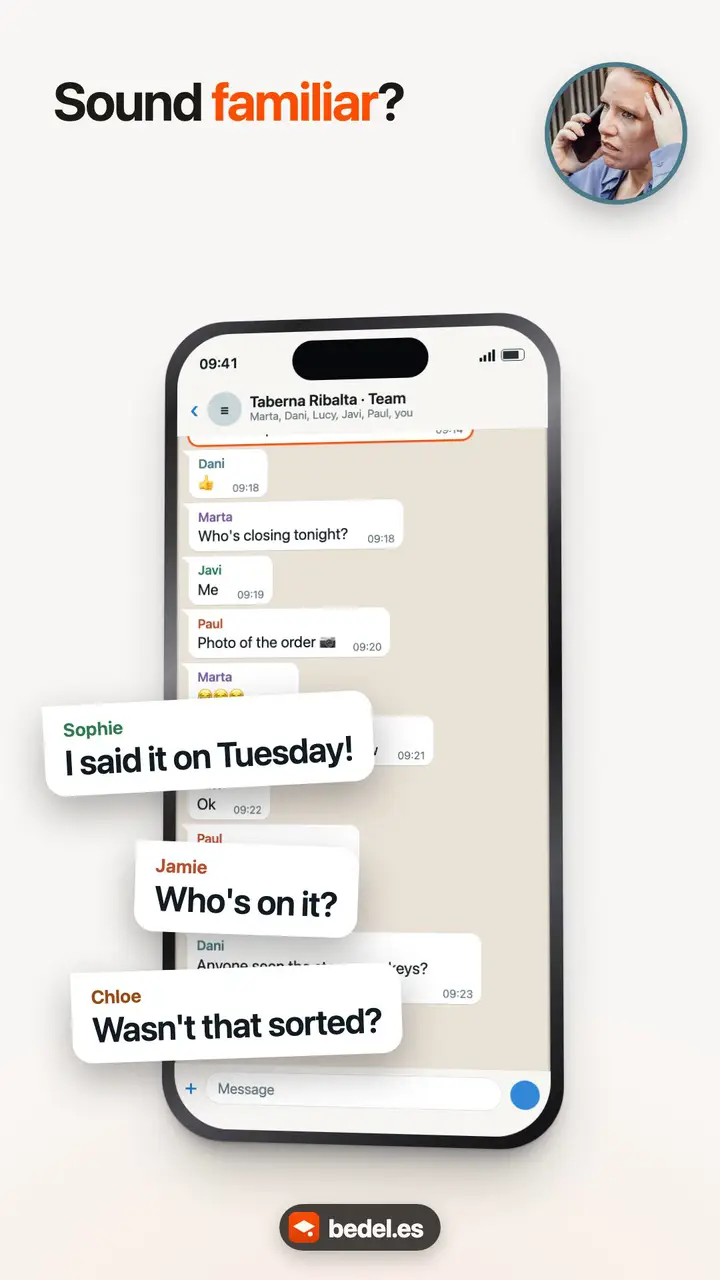
At the point where corrective work comes in, and in alerting whoever has to act. WhatsApp is already on the phone of every member of staff, of whoever fixes things and of the person in charge, and nobody needs training to send a photo. The trouble with WhatsApp as it comes is the group: the fault gets mixed up with the rota, nobody knows whether anyone has taken it, and three days later it is twenty screens up. What changes things is having something behind the number that turns each message into a ticket and chases it.
That's what we do at Bedel with the business's WhatsApp, and which part runs on its own is covered in automatic incident handling on WhatsApp:
- It comes in the way people tell it. Text, a photo on its own or a voice note. The assistant works out what is broken, where and how urgent it is, and asks for the location if it's missing.
- An acknowledgement with a number. Whoever reports gets the fault ticket number in the same reply, and then every step: when someone takes it, for when, and when it's closed.
- To the phone of whoever handles it, not to a group. The report goes to the person in the role according to the shifts you set, with buttons to take it today, take it tomorrow, ask for more information or pass it on.
- Deadline and escalation. Each category has its deadline, with one reminder halfway and another close to the end. If it passes, the ticket goes up once to the person above; urgent ones ring again every day until they're closed.
- At night, only what's urgent. Whatever you mark as urgent rings on the on-call phone; the rest waits for the shift. Gas, smoke, fire or someone hurt alert the team straight away.
- A trail. Every ticket keeps three times, reported, taken and fixed, in an Excel sheet that belongs to you, with a dashboard of times over 7, 30 and 90 days and a summary every night there were tickets.
- And dated preventive work, remembered. We load the inspections you already keep in your spreadsheet, and every month they reach whoever runs maintenance on WhatsApp, with enough notice to book them.
When a classic CMMS is the better choice
Some maintenance operations outgrow a chat, and it's better to say so before anyone finds out halfway through a contract:
- You have full-time in-house technicians and want to plan their week with work orders that are assigned, carried out and closed.
- You need a record for each asset with its history, its spare parts and what it has cost, to decide whether to repair or replace it.
- There is a stock of spare parts and you want to know what each work order uses.
- Several sites that you want to compare on one screen.
- Machines with sensors that have to open the request on their own, without a person writing it.
- An audit asks you for the certificates filed alongside each inspection.
If that sounds like you, you need a CMMS. How to choose one with criteria that make sense for premises is in best CMMS for businesses with premises, and if you're torn between software and the spreadsheet you already keep, see CMMS or Excel. If what gets lost isn't the work order but the report itself, the problem is a different one, and it's covered in WhatsApp group or incident manager. The products sold as incident managers, and how they differ from an IT help desk, in incident management software.
Maintenance at each kind of business
The journey of a fault is the same everywhere; what changes is who spots it, who fixes it and which inspections the law requires. How it works at each one is on its WhatsApp incident management page:
- Restaurants: the cold room, the extractor hood and the dishwasher, nearly always with outside technicians.
- Hotels: what housekeeping finds in a room and has to be fixed before the next arrival.
- Gyms and sports centres: machines, changing rooms, the pool and its chlorine. The products, compared, in gym maintenance software.
- Offices and coworking spaces: the air conditioning, the meeting rooms and the network, in someone else's building.
- Shops and franchises: the shutter, the lighting and the till, one outlet at a time. The products, compared, in store maintenance software.
- Blocks of flats: the entrance, the lift and the shared areas, with the managing agent in between.
- Schools and academies: what the caretaker or a teacher sees before anyone else.
- Clinics: the treatment room and the equipment, with no patient data going through the chat. The products, compared, in clinic maintenance software.
- Schools and academies: what the caretaker or a teacher sees before anyone else. The products, compared, in school maintenance software.
- Clinics: the treatment room and the equipment, with no patient data going through the chat.
- Veterinary clinics: the ward, the theatre and each supplier with their report.
- Warehouses and workshops: the machine that stops, where there is usually a CMMS already and what's missing is the way reports come in. The products, compared, in maintenance software for warehouses and plants.
Student residences and halls have their own journey, with residents reporting from their rooms; it's on the Bedel home page.
The three kinds of product sold as a CMMS, and how to choose between them, in maintenance software.
Where Bedel fits, and what it does not do
Bedel is not a CMMS. It is the way faults come in and are followed up through the business's WhatsApp, plus the reminder of dated inspections. For many businesses that is all the maintenance there is to manage; for others, it is the half their CMMS doesn't cover. What it does not do:
- It keeps no asset register or equipment records.
- It does not raise work orders with parts, hours or costs.
- It does not store inspection certificates or reports, which stay in your files.
- It does not connect to other software: what comes out of Bedel is its Excel sheet.
- It does not bring several sites together on one screen: each site is one account, with its own number.
- End customers don't open tickets on their own: the people on the business's list do the reporting.
The data is stored in the European Union; your business is the controller and Bedel the processor, with the processing contract published.
Frequently asked questions
What is a CMMS and what is it for?
It's computerised maintenance management software (called a GMAO in Spain). It's used to keep the asset register, work orders with their parts and hours, and the planned maintenance schedule. It's very useful where there are in-house technicians and expensive equipment; at a small business, what usually fails comes earlier: how the fault report arrives.
Can maintenance be run on WhatsApp?
The way faults come in, yes, and that's where it works best, because every member of staff already uses it without training. What doesn't work is the group chat: it keeps no time, it doesn't say who has taken the job and the important things sink. Each message has to become a ticket with a number, an owner and a deadline. The asset register and the costs, on the other hand, don't fit in a chat.
What's the difference between corrective and preventive maintenance?
Corrective maintenance is done after something fails, to get it working again; preventive maintenance is done beforehand, on a date, so the failure doesn't happen. At premises in Spain much of the preventive work is set by law (extinguishers, heating and cooling, low voltage, legionella, lifts) and is carried out by a maintenance contractor. Corrective work is started by anyone on the team who spots the fault.
Does a restaurant or a shop need a CMMS?
It depends on whether it has in-house technicians, a lot of equipment or several sites to compare. If maintenance is done by outside firms and what gets lost is the reports, a CMMS adds software that someone has to keep fed without fixing the way reports come in. In that case a reporting channel with a trail and a spreadsheet of dated inspections is usually enough.
Is Bedel a CMMS?
No. Bedel keeps no asset register, raises no work orders with parts and costs, stores no certificates and doesn't connect to other software. It collects faults through the business's WhatsApp, puts them on the phone of whoever fixes them with a deadline and buttons, tells whoever reported about each step, keeps three times per ticket in an Excel sheet and reminds you every month about dated inspections.
Can it sit alongside the CMMS we already have?
Yes, separately: reports come in and are followed up in Bedel, and the asset register, work orders and costs stay in your CMMS. There's no link between the two today, so anything that needs to go into the CMMS goes in from Bedel's Excel sheet. If that's a lot of work for you, we'll talk it through on the call before starting.
Comparisons
- Maintenance software: types and how to chooseThe three kinds of maintenance software, six questions to choose yours, what planned and reactive maintenance each need, and the software for each sector.
- Automatic incident handling on WhatsAppWhich part of an incident can be answered and moved on its own over WhatsApp, what a person still does, and how it differs from an auto-reply or a chatbot.
- WhatsApp for hotels: guest customer serviceThe four types of WhatsApp software for a hotel, what each one solves, and why guest service usually fails after the conversation: when what the guest asked for has to be fixed.
- Maintenance software for hotels in Spain, 2026Six criteria built for a hotel, ten products described with what their websites say, and where Bedel fits, which is not one of them.
- Maintenance software for restaurants, 2026Six criteria built for a kitchen, nine products described with what their websites say, and where Bedel fits, which is not one of them.
- Maintenance software for buildings in Spain, 2026Six criteria built for a building, ten products described with what their websites say, from CMMS to block management, and where Bedel fits.
- Incident management software for on-site faultsSix criteria so you don't buy a help desk when what gets lost is faults, eight products described with their own websites, and where Bedel fits.
- Incident management app in Spain, 2026Eight incident apps described with their own websites, six criteria to choose, and the question almost nobody asks: who has to install it.
- Gym maintenance software in Spain, 2026Six criteria built for a gym, seven products described with what their websites say, from CMMS to membership software, and where Bedel fits.
- Clinic maintenance software in Spain, 2026For clinics and clinic groups, not hospitals: six criteria, seven products described with what their websites say and where Bedel fits.
- Store maintenance software in Spain, 2026For a shop or a store network: six criteria, five products described with what their websites say and where Bedel fits.
- School maintenance software in Spain, 2026For state and private schools: six criteria, seven products described with what their websites say and where Bedel fits.
- Industrial maintenance software for warehousesFor factories, warehouses and logistics sites: what to check, six CMMS summarised from their websites and the gap left by reporting from the workstation.
- Preventive maintenance software: how to chooseWhat a preventive plan holds, the three kinds of recurring task on a site, how a CMMS handles them and how a reminder tool does, and when each is needed.
- Corrective maintenance software: what to ask of itThe journey of an unplanned fault in five moments, what goes wrong at each without software, how urgency, deadline and escalation are set up, and which times are worth measuring.
- Work order management: full order or simple ticketWhat a work order is and where it comes from, what a full system holds, how it differs from a fault ticket and the signs that a business with premises needs one or the other.
- Fault management software: how to choose oneThe path of a fault from whoever reports it to whoever repairs it: the reporting channels and what each one loses, sorting by trade, the outside supplier, the photo and the status sent back.
- Maintenance app: who actually opens itThe four phones a fault passes through, what an app asks of each, why it is dropped where staff turn over, seven demo questions and the no-app alternative.
- Maintenance request software: intake channelsThe six channels a maintenance request comes in through, the four details it needs, who sorts it and how the person who made it gets an answer.
- CMMS with WhatsApp: add-on alert or the way inThe two things sold as a CMMS with WhatsApp (an added notification or the entry point), five questions to tell them apart and who each one suits.
- CMMS for small business: what you need and don'tWhat a small business with premises asks of maintenance, what it can leave out of a full CMMS, a yes-or-no test to see if you need one and five steps to start.
- CMMS software: what it is and who needs all of itWhat CMMS software is, why it is the same thing as a GMAO, what each part is called by country, what it holds and which businesses need all of it or only the report.
- Facility management software: what it coversThe areas of a facility management suite, which ones weigh on a small or mid-size company's facilities team day to day, and the only one Bedel covers.
- Mandatory inspections software for premisesThe inspections Spanish law dates for premises, who carries them out, what is left to the owner and how far a program and a WhatsApp reminder can go.
- Maintenance software for offices: what to checkWhat breaks in an office, whose job each repair is between tenant, landlord and supplier, what to demand of a product and the part Bedel does.
- Residents' association fault reporting softwareFaults in the common areas, who reports them, which trade fixes them, what the managing agent needs to know about each one and the part Bedel covers.
- Maintenance software for coworking spaces: a guideA coworking space's faults seen from the operator's side: who reports them, whose they are, what to ask in a demo, when a CMMS is worth it and Bedel's part.
- Maintenance software for franchises: site by siteMaintenance in a franchise network, with its two owners: what falls to the franchisee, what head office watches, what to ask in a demo and the part Bedel does.
- Maintenance software for sports centres and poolsSports centres, clubs and pools: what fails in the water, the changing rooms and the courts, which checks the rules ask for, when a CMMS suits and what Bedel does.
- Maintenance software for academies: what to askWhat breaks in a language school, a tuition centre or a training centre, who sees it between lessons, when a CMMS is too much and the part Bedel covers.
- Maintenance software for veterinary practicesThe faults of a veterinary practice or hospital: kennels and climate, theatre, autoclave and X-ray, each with its official service; questions for the demo and Bedel's role.
- AI for hotels: what to buy, bookings to repairsA buyer's guide: the four areas of a hotel where AI works today, who decides in each, the questions for the demo and the stretch Bedel covers.
- WhatsApp at work in Spain: group or incident managerWhatsApp groups at work in Spain: what the AEPD has ruled, what the right to disconnect adds and how a group compares with an incident manager for faults on business premises.
- CMMS or Excel for maintaining business premisesWhen a spreadsheet is enough and when a CMMS is needed, how to build the preventive plan in Excel and which records the law says to keep.
- Best CMMS 2026: a comparison for small premisesSix criteria built for premises, seven CMMS described with what their websites say, and where Bedel fits, which is not one of them.
Rules by sector
- Restaurants and barsThe obligations of a restaurant or a bar in Spain: what is specific to the kitchen and the checks on the premises, each with the condition that triggers it, how often it applies and its article.
- GymsA gym: no national law; qualifications, insurance and notices under each region's sports professions act, plus low voltage, Legionella, pool, RIPCI and defibrillator as premises.
- HotelsA hotel: guest register and reporting within 24 hours, regional classification, low voltage and lift as a public-assembly venue, RIPCI, Legionella, pool, kitchen and defibrillator.
- Residents' associationsThe obligations of a Spanish residents' association: upkeep, reserve fund, owners' meeting and administrator under the Horizontal Property Act, building logbook, building inspection and the checks on each communal installation.
- Shops and franchisesA shop: responsible declaration up to 750 m², opening hours, prices, franchises with no register since 2018, complaint forms, accessibility adjustments and the inspections of premises open to the public.
- OfficesThe obligations of an office in Spain: temperature and upkeep of the premises, screen work, health and safety, coordination with contractors, internal reporting channel, right to disconnect and building checks.
- SchoolsA school: minimum facilities, protocols against violence and a wellbeing coordinator, canteen and menus from April 2026, self-protection and the building inspections.
- Industrial unitsAn industrial unit: fire inspection every five years under the 2025 regulation, chemical storage (APQ), air receivers, work equipment, low voltage, cooling towers and self-protection.