English
Bedel in 30 seconds
Everything that comes in through your WhatsApp. And where each thing goes.
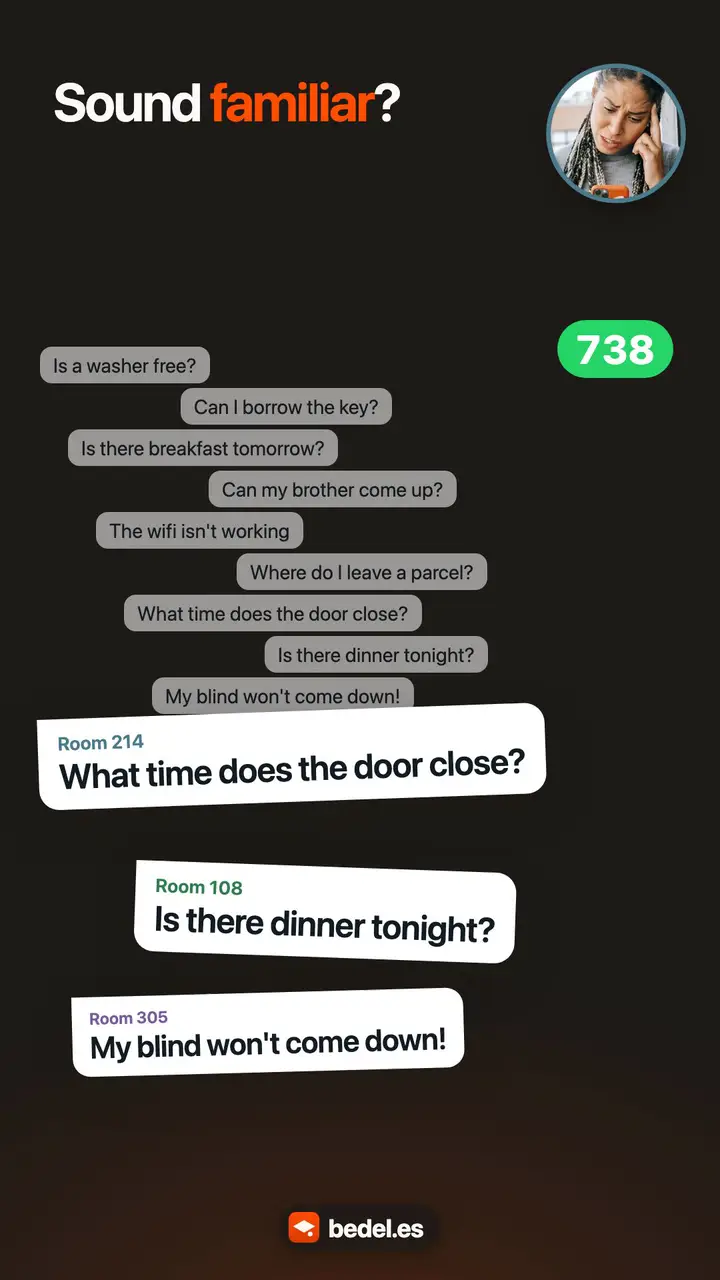
The WhatsApp of your university hall, answered.
It answers your residence's WhatsApp at any hour. And what isn't its call, it puts on the phone of whoever is responsible.
Book your demoPick your time
We'll show it working in your university hall.
or message us on WhatsApp · call us on +34 681 676 697
what time does the dining hall open tomorrow?
🤖 I'm the centre's AI assistant (not a person). Type HUMANO if you'd rather talk to the team. 🔒 Your data is handled by the centre. Type PRIVACIDAD to see how. Breakfast is 7:30 to 9:30 (8:00 to 10:30 on Saturdays). Morning! 🙂
hi! the blind in my room is broken and won't come down
Sorry about that 👍 Which room is it?
214
✅ Done. The team has it — it's logged as #412. I'll let you know as soon as there's news.
Bedel answers your university residence's WhatsApp at any hour and in the language the person writes in, including the exchange student who arrives in February. What isn't its call to make goes to the phone of whoever is responsible. It's the communication software between the residence, its residents and their families.


A broken radiator shouldn't take 4 trips to reception.
The resident loses time and reception answers the same thing again and again, sometimes in three languages.
One repair can take up to 4 trips to reception.
The resident reports once and follows the repair from their own WhatsApp.
Dashboard
Metrics management sees
- Time to accept
- Time to resolve
- Issues by type
- Overdue right now
- Meta Tech Provider
- Data hosted in the EU
- GDPR
- Spanish Law 3/2022 channel
- Support in Spain
Who wins
For the resident, the team and the residence.
TodayWalks down to reception four times about the same radiator. And at eleven at night, just arrived from another country, has no idea whether anyone has read the message.
- An answer right away, at any hour.
- Told when someone takes the repair and when it's fixed.
- If they ask how it's going, they know where it stands.
- Same answer, whoever is on the reception desk.
TodayIn September and again in February the team gives out the wifi password forty times. And spends the morning calling the contractor to find out who has each repair.
- Each repair goes to the right person's phone, even at an outside company, with its category and deadline.
- Questions about the rules, answered from your own documents. Anything not written down goes to a person.
- Nobody has to call the resident to say how it's going.
- "Please don't clean my room tomorrow" reaches cleaning without going through reception.
TodayNobody knows how long the contractor took to fix the last repair, or which third-floor bathroom has broken four times this year.
- How long it takes to pick up and to resolve each repair.
- What keeps coming back: the same bathroom, the same blind, the same weekend.
- Every month, a report: the data, what it means and what to decide.
- The next month, whether it worked.
The residence dashboard
The whole residence, in one dashboard.
It's the residence's CRM: whatever comes in on WhatsApp, filed with its time and its owner.
The hours your team hasn't spent answering, not rounded up.
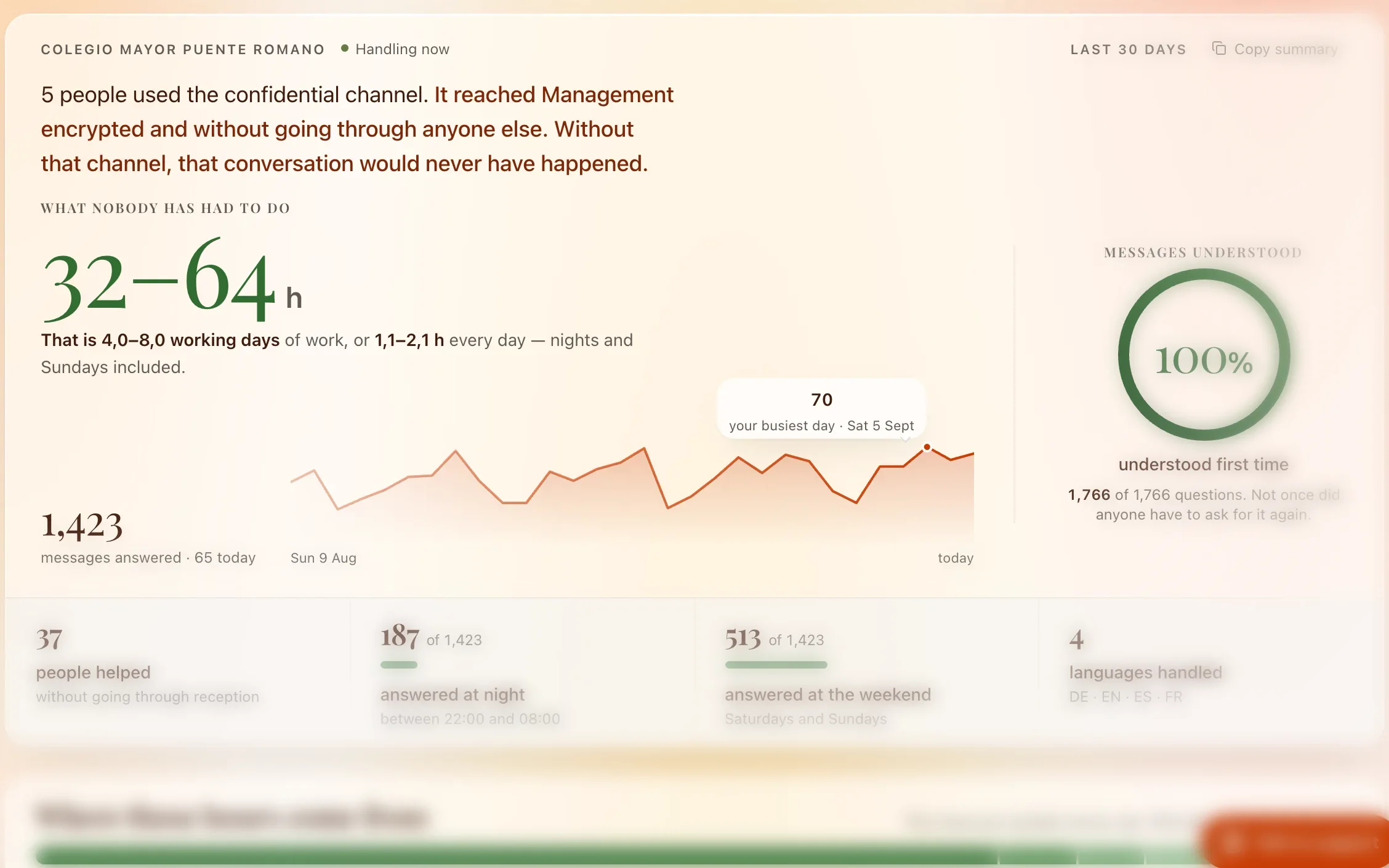
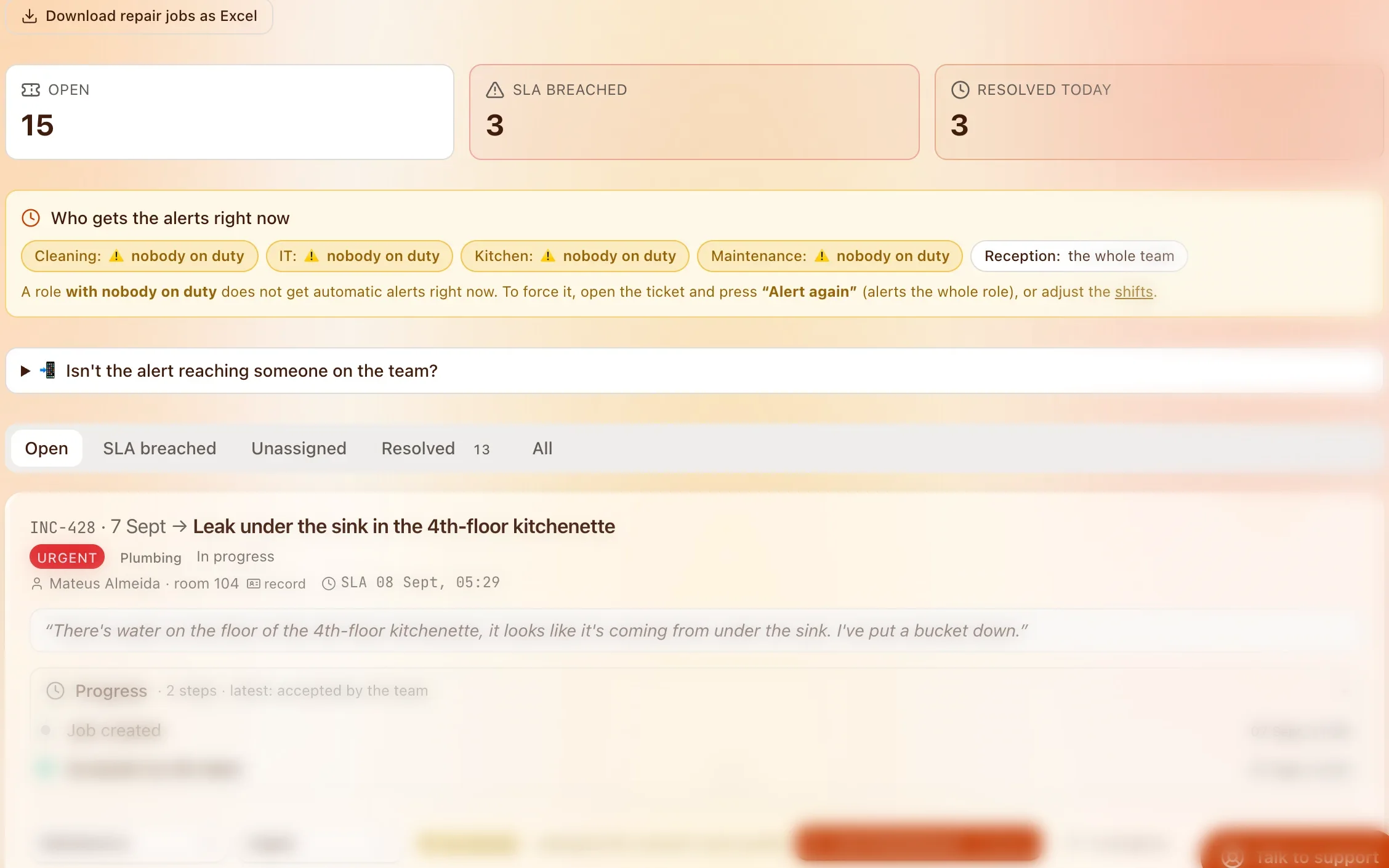
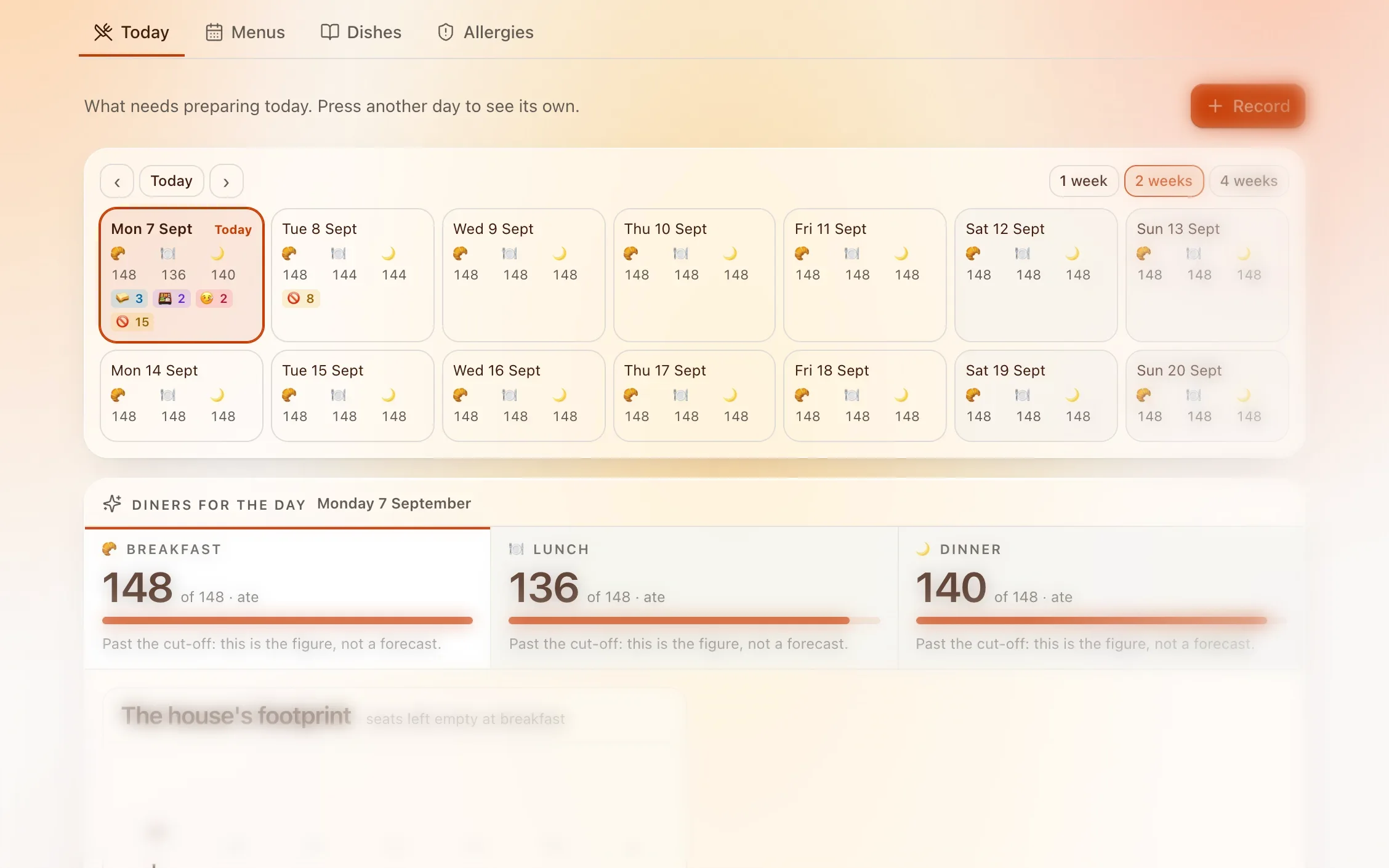
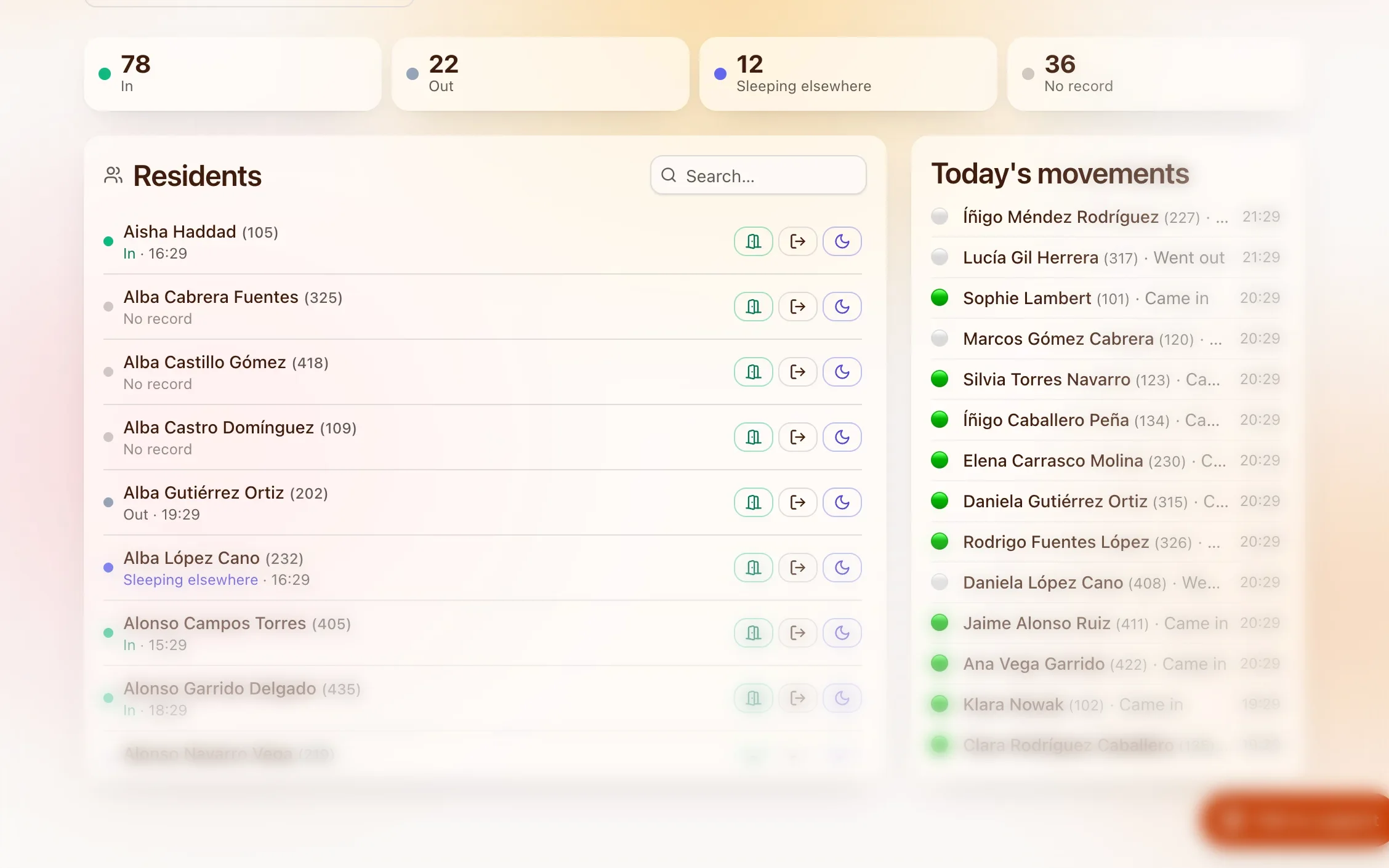
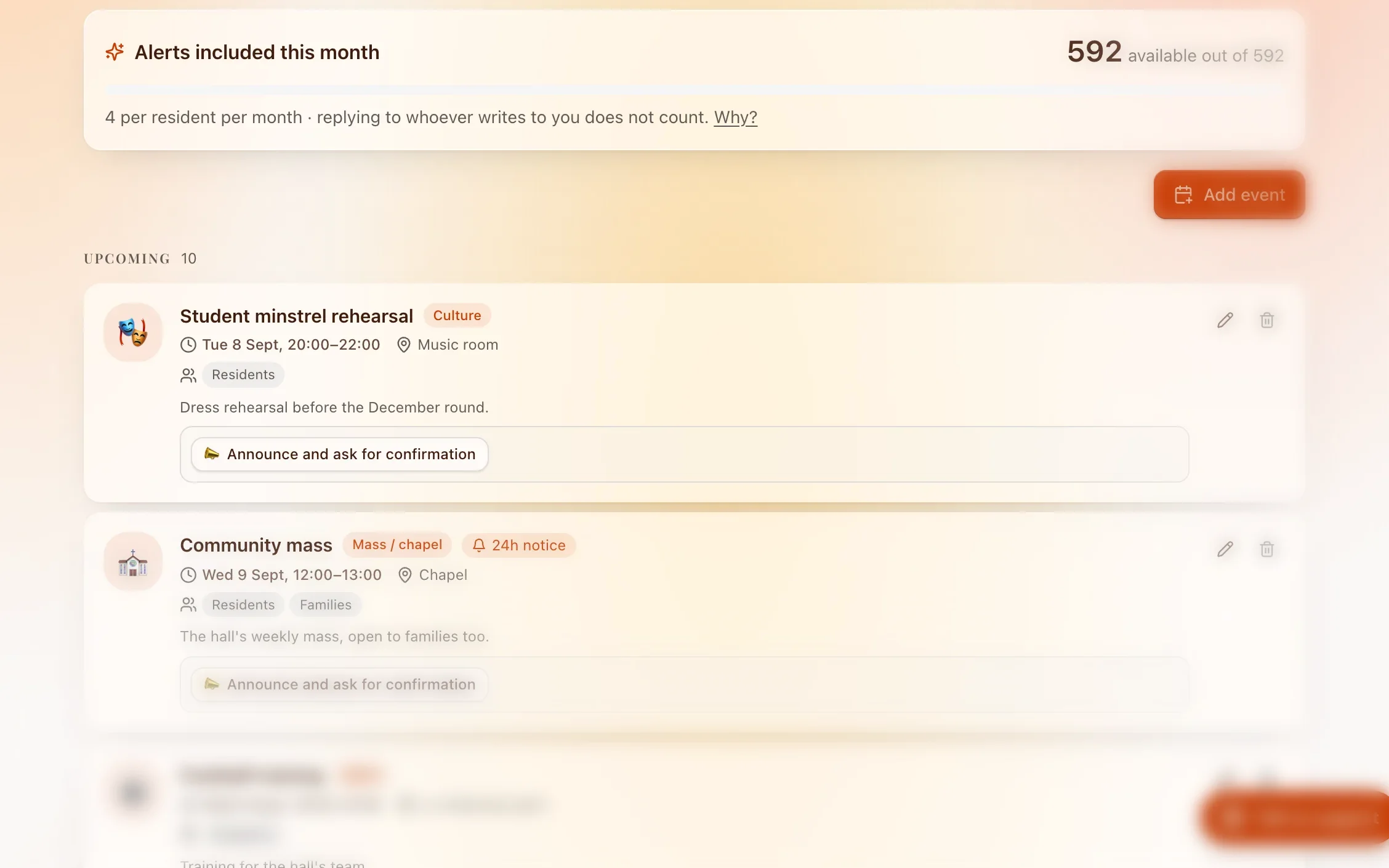
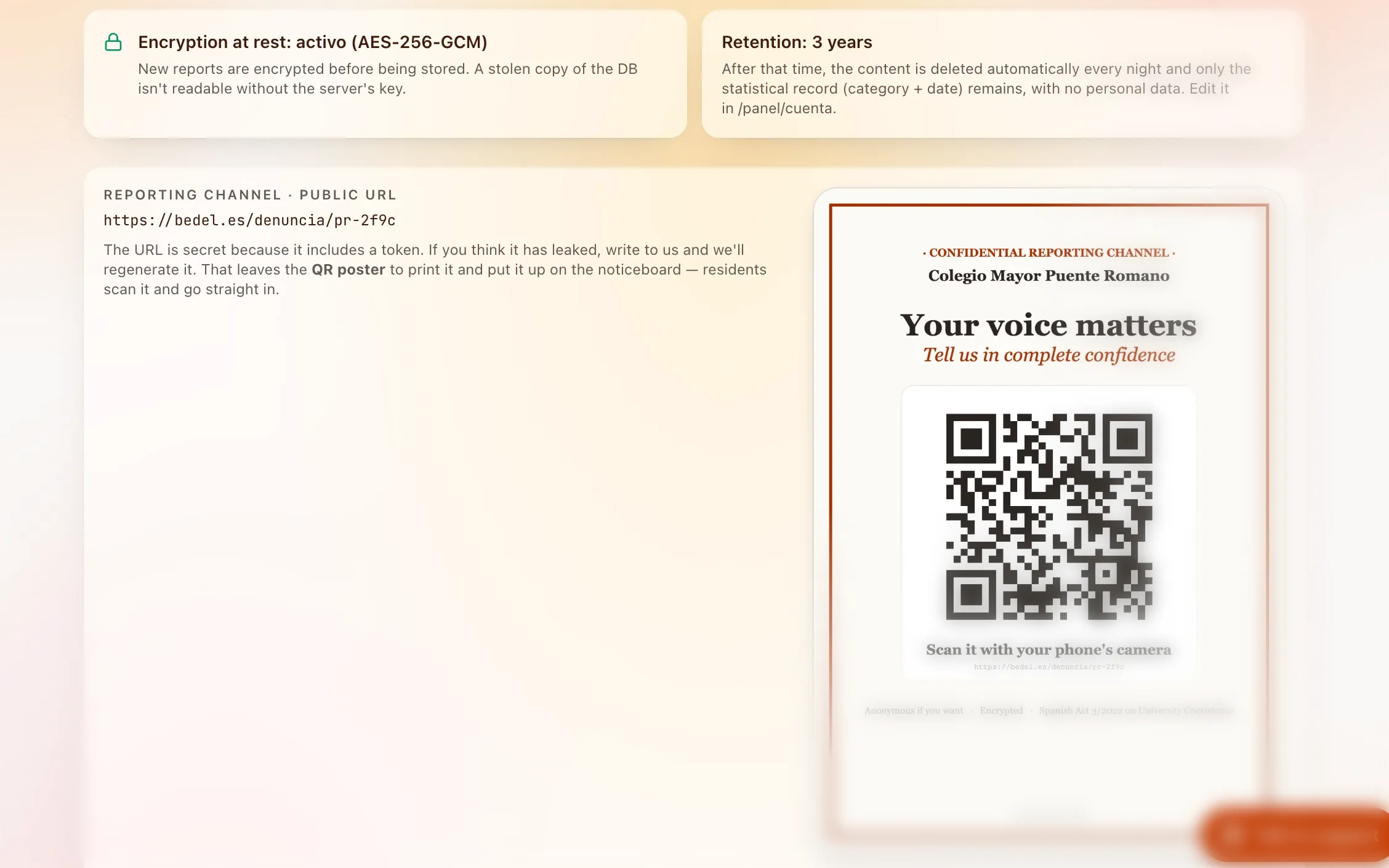
And 17 more screens that don't fit here
- Control room
- Team alerts
- Front desk · parcels
- Spaces and bookings
- Admissions and places
- Information requests in Excel
- The centre's house rules and FAQ
- Parents and families
- Shifts and on-call
- Absences and delegations
- Announcements to the whole centre
- Centre metrics
- Per-resident metrics
- Team performance
- Users and permissions
- The centre's own WhatsApp
- Test sandbox
Real screenshots of the dashboard, with invented data.
Six things that happen in the residence from day one.
The usual WhatsApp, no app.
Nobody downloads anything: residents, wherever they come from, write to the number they already have saved.
Arrival day, with no queue at reception.
Wifi, opening hours and house rules are asked on WhatsApp, in September and in February.
It answers from your internal rules.
Visitors, quiet hours, nights away: what isn't written down it doesn't make up, it passes to a person.
Cleaning knows which room to skip.
"Don't clean room 318 tomorrow" reaches the cleaner's phone, whether in-house or from the contractor.
Questions about places, answered at any hour.
Whoever asks about the call for places gets the conditions you've written and is put on the list.
The repairs log, ready for the contractor.
Everything goes to Excel, and every night the day's summary lands in the director's inbox.
Two centres already live this way.
62–115 h
of estimated work the team did not have to do · 19 days, two residences.
47 %
of what residents write arrives outside 9am–6pm · 452 of 957.
 Madrid · Since 1944Colegio Mayor Universitario de San Pablo
89 of 89
residents have written to the channel. Nothing to install.
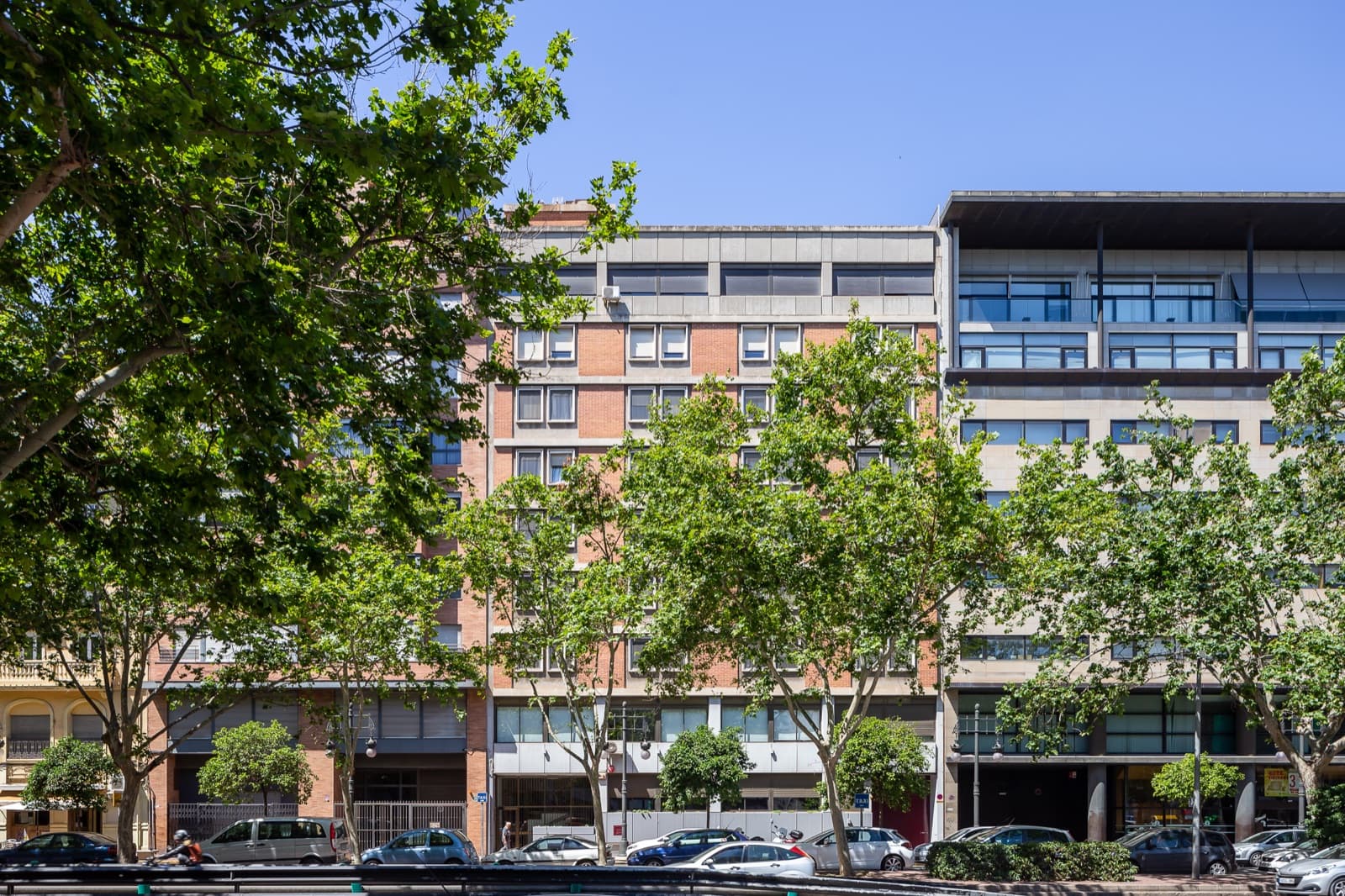 ValenciaResidencia Universitaria Anunciata

Two operating residences —a student residence and a hall of residence— added together, from 1 to 19 September 2026. It does not count what the centre's own team writes. A reply is a message from Bedel to someone who has just written (under 10 minutes); automated notices don't count. Office hours: Monday to Friday, 9am to 6pm. Hours are estimated with minutes per task (answering, 1–2 min; opening a repair, 4–8 min), with no rounding up, and come to 7.9–14.4 working days of 8 hours. The 89 residents are those of the student residence, since 1 August.
No surprises. Always at hand.
Secure and compliant
What you will be asked about, already solved.
- The confidential reporting channel you are required to haveSpanish Act 3/2022
- Data in the EU, and deletion that actually deletesGDPR
- We flag what you believe is covered and isn'tFalse coverage
- Meta Tech ProviderWhatsApp Business Platform · authorised directly by Meta, with no resellers or intermediaries in between
Always at hand
Real people, in Spain.
or message us on WhatsApp · call us on +34 681 676 697
Shall we talk for 30 minutes?
We'll show you in a demo, with your university residence inside.
- You pick a time that suits you
- We show it to you with a case like yours, in 30 minutes
- If it fits, we leave it running on your WhatsApp
or message us on WhatsApp · call us on +34 681 676 697
Pick a slot and you're done.
For university-owned and affiliated residences
The university's residence answers on WhatsApp, including whoever arrives in February
First Monday in February, nine at night. Fourteen second-semester students have arrived: three ask in English for the wifi password, one asks in Italian what time reception closes and another sends a photo of a dripping radiator. There is one person on reception until ten; maintenance belongs to a company that starts at eight, and cleaning to another one. Bedel is the one answering that WhatsApp: it settles what repeats from what the residence has written down, opens the radiator ticket with its deadline for the contractor and leaves on a person's phone what a machine should not decide.
What it is and what it is not. Bedel is support and communication software for the day-to-day of a university residence. It is not the application system for places, nor the university's management system: it does not allocate rooms, does not charge and does not control access. Nor does it replace management or the university's housing office: what is not its to handle, it passes to a person, with the conversation in front of them, and leaves it in writing.
What a resident writes, and who finds out about each thing
- What the resident writes: "I arrive on Sunday at 11 pm. Is reception still open?"
- What Bedel does: Answers in English with the opening hours the residence has written down. If nothing says what to do with a late arrival, it does not make it up: it passes it to the right person according to the org chart
- What the resident writes: "When does the call for places for next year open?"
- What Bedel does: Answers with the text the residence has prepared for when there are places and for when there are none, sends the information document if there is one and puts whoever asked on the dashboard's list of applicants. It allocates nothing
- What the resident writes: A photo of a dripping radiator in room 318
- What Bedel does: Opens a maintenance ticket with category and urgency and notifies the maintenance post, even if it is an outside company's technician with their own WhatsApp. The resident knows when it is accepted and when it is closed
- What the resident writes: "Please don't clean my room tomorrow, I have an exam at nine"
- What Bedel does: Logs the request for that day and sends it to whoever cleans, with the room number. If the cleaning post has working hours and the message comes in outside them, it is held and reaches them when they start
- What the resident writes: "I'm going home from 20 December to 8 January"
- What Bedel does: Logs it in the absence log, one row per night. The evacuation plan does not count someone who is away, and on the morning they are due back it asks "Arriving today?" with two buttons
- What the resident writes: "Can I book the study room on Thursday from 6 to 8 pm?"
- What Bedel does: Books in slots with the capacity and the weekly cap per person the residence sets; if it is already full in exam week, it says why it does not fit
- What the resident writes: "I want to tell someone about something that happened on my floor and I don't know who"
- What Bedel does: Takes it through the confidential channel, right there or on the residence's own form, anonymous by default. The account is encrypted and every reading is logged
Management, reception and two contractors: every notice to its place
In a university residence the in-house staff is usually small (management, someone in administration and reception) and maintenance and cleaning are run by a company under contract. Bedel does not notify a group: it uses the org chart and shifts the residence configures, and that org chart has room for outside people with their own WhatsApp.
- A post is a group of people with their phones, whoever pays them: the contractor's technician gets the ticket with the photo and accepts or closes it with buttons.
- Urgent matters go to the whole post; the rest, to the first person in that shift's rotation. If nobody picks it up, it goes up to the area lead and then to management.
- Each post can have its own working hours. What arrives while the contractor is not working and can wait is held in a queue the dashboard shows, and delivered when they start.
- Reception talks to the resident from the same number and sends announcements to the whole house or to one floor by room range. What the team writes goes out as written, untranslated.
- What the AI answers alone and what it always leaves to a person, with the rule that requires it, in AI for student residences in Spain.
The year has two intakes: September and February
A university residence does not fill up once. It fills up in September and fills up again halfway through the year, when the first-semester exams end and the exchange students arrive (those on Erasmus and on other agreements) who only come for half the academic year. Every intake brings the same questions, and every departure leaves a bed that should be counted as free on the right day, not a week later.
- The resident list is uploaded in whatever spreadsheet you already keep, with the columns named however they are named: besides name, phone and room, it takes the day each person starts living there and the last day they spend in the house.
- Whoever arrives in February does not count in the evacuation plan (nor in the kitchen, if there is a dining hall) until their first day; whoever leaves in January stops counting the day after their last.
- If you keep occupancy in a room rack, Bedel reads it, matches each row by name against someone already registered and returns it up to date. It registers nobody on its own.
- First-day questions (wifi, opening hours, house rules, where to pick up a parcel) are answered from what the residence has written down, in the language of each person's last message and without touching times or links. What is not written down reaches a person.
Outside maintenance and cleaning, with everything in writing
When maintenance belongs to an outside company, the difficult conversation is always the same one: how long they take and what keeps coming back. Bedel keeps every maintenance ticket with the time it came in, who took it, when it was closed and with which photo, and the same for what is asked of cleaning. With that, the meeting with the contractor runs on data and not on memory.
- A reminder to whoever owns the ticket at 50 % and 85 % of its category's deadline; an urgent ticket past its deadline sounds again once a day and after three days goes up to management.
- If the same room repeats the same fault within twelve months, the technician receives it flagged as repeated.
- Cleaning receives "do not clean", "come later" and "urgent" with the room number and two buttons: their summary for the day and their tasks.
- The tickets spreadsheet comes out with the columns of your own log, and the dashboard shows over 7, 30 and 90 days how long it takes to pick up and to resolve each notice.
Coexistence: what belongs to the residence and what belongs to the university
Spanish Act 3/2022 on university coexistence does not name residences. It binds public universities and their public affiliated centres (art. 2.1), and lets private universities and private affiliated centres approve their own rules on its principles (art. 2.2). An affiliated residence is reached by its university's Coexistence Rules through the affiliation; a university-owned one, because its internal rules are drawn up under the university's statutes (Spanish University Student Statute, art. 66.5). A private residence with no university link is not reached by the Act.
- Disciplinary authority over students lies with the rector's office (art. 8). The residence does not impose the sanctions in the Act, and Bedel decides none.
- What the Act asks of the university is a channel for complaints about violence, discrimination or harassment (art. 4.2). Bedel provides the house's own: a confidential channel with the account encrypted, and management gets the notice that there is something to read, without the content.
- If the residence belongs to a public university, the fifty-employee threshold does not apply: Spanish Act 2/2023 requires public universities to have their own internal reporting system (art. 13.1.d). That system belongs to the university, and the residence's channel does not replace it.
- What each law asks of whom, in the coexistence rules guide and in the colegio mayor or university residence guide.
Data, when there is a university behind the residence
Whoever decides what residents' data is processed for is the data controller: the university, if the residence is its own; the owning entity, if it is affiliated. Bedel processes the data on that controller's behalf and under a contract that says so.
- The data processing agreement and the record of processing activities are published, so the university's legal department can read them before the first meeting.
- The database and the functions live in the European Union, in Ireland; the AI model runs in the United States under the Standard Contractual Clauses.
- In the regions with their own data protection authority, that authority supervises its public sector and those who provide services to it (Spanish Data Protection Act, art. 57): the residence of a public university may answer to it rather than to the national authority (AEPD).
- If the university classifies the places as university housing and assigns them to its students, the Spanish Urban Leases Act does not apply (art. 5.d) and the rules of use are set by the university. Those are the rules Bedel answers from.
What it does not do, said before the demo
- It does not run the call for places or allocate them. In a university-owned residence access goes through a public, objective and transparent procedure (Spanish University Student Statute, art. 66.3), and that procedure is yours: Bedel attends to whoever asks and puts them on the list.
- It has no combined view: one account is one residence. A university with three residences has three accounts, and no screen adds them up.
- It is not the university's management system: it does not charge, does not allocate rooms and does not control access, cards or locks.
- It does not decide sanctions or exceptions to the rules, and it does not replace the Coexistence Committee or the university's internal reporting system.
- It does not translate announcements or what the team writes in the direct chat.
- It is not certified under Spain's National Security Framework (ENS). If your university's procurement file requires it, it is worth saying so on the first call.
Frequently asked questions
Does Spanish Act 3/2022 apply to a university residence?
It depends on the residence's link with the university. The Act binds universities (art. 2) and does not name residences. An affiliated residence is reached by its university's Coexistence Rules through the affiliation; a university-owned one, because its internal rules are drawn up under the university's statutes; a private residence with no university link is not reached. In every case, disciplinary authority over students lies with the rector's office (art. 8). Bedel provides the confidential channel and the rule that a coexistence complaint is read by a person.
Can it run the call for places?
No. It answers whoever asks about a place with the text the residence writes for when there are places and for when there are none, sends the information document if you have uploaded it, can state the admission condition you set (for example, being enrolled at the university) and puts that person on a dashboard list with their status. The application, the scoring and the allocation stay in the university's procedure, and the nightly email says how many enquiries about places there were.
Does it work if maintenance and cleaning are run by an outside company?
Yes, and it is the most common case. Each post in the org chart is a group of people with their WhatsApp: the contractor's technician receives the ticket with the photo, accepts it and closes it with buttons, and whoever cleans receives the requests for each room. What Bedel does not record is the contract with the company or each worker's hours: that stays in your accounts.
What about students who arrive halfway through the year?
They are registered with their first and last day, in the same resident spreadsheet or one by one from the dashboard. Until that first day they do not count in the evacuation plan or in the dining hall, if there is one, and from the moment they write they are answered in their language from what the residence has written down: the wifi, the opening hours, the rules, how to report a repair. When they leave, the residence carries out their right to erasure from the dashboard: their conversations and presence are deleted, and the tickets they opened lose their name.
The university has several residences. Can they be seen together?
No. In Bedel one account is one residence, with its number, its org chart, its rules and its dashboard; a university with three residences has three accounts and there is no screen that adds them up. Each management team gets its own email every night, the weekly one on Sundays and the monthly one on the last day of the month, with what came in out of hours, the languages, the incidents and the enquiries about places, and can forward it to whoever looks after the residences at the university.
Who is responsible for the data, the residence or the university?
Whoever decides what it is processed for: the university, if the residence is its own, or the owning entity, if it is affiliated. Bedel processes the data on that controller's behalf, under a published data processing agreement that can be signed. The AI model's provider does not train on the centres' data. If the residence depends on a public university in a region with its own data protection authority, it may be that authority, and not the national AEPD, that supervises it.