English
Bedel in 30 seconds
Everything that comes in through your WhatsApp. And where each thing goes.
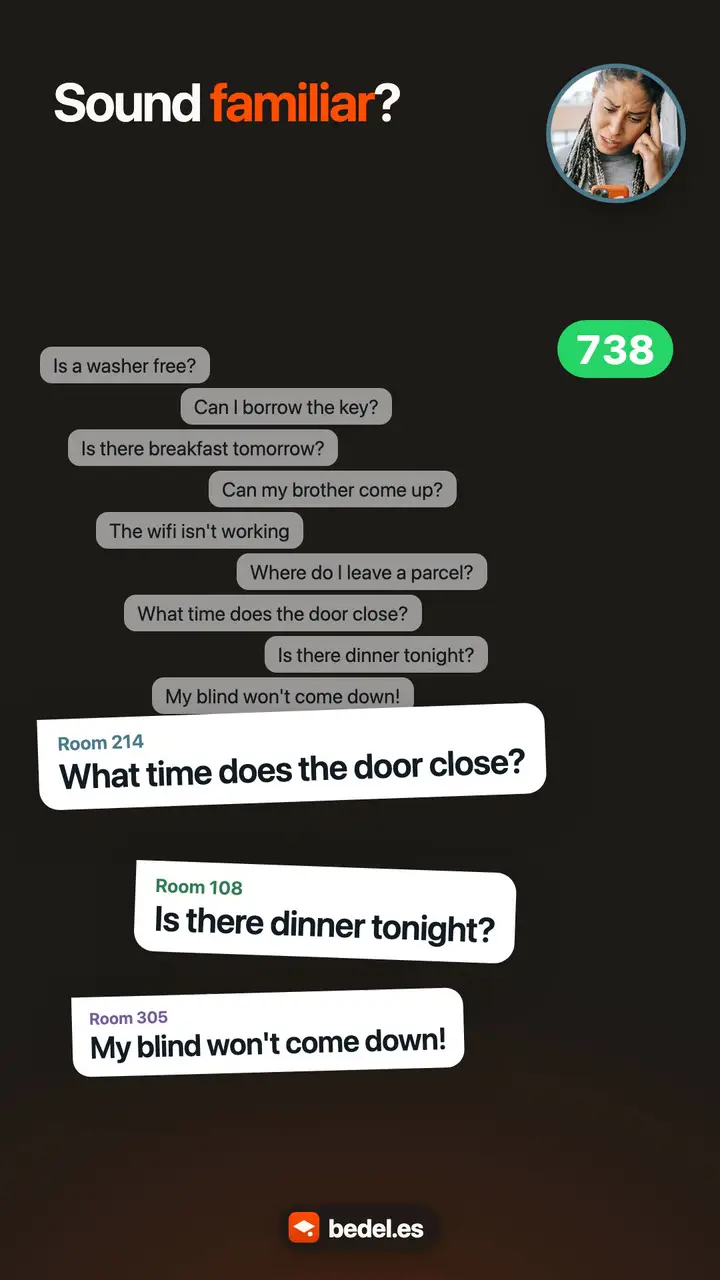
The WhatsApp of your research housing, answered.
It answers the residence's WhatsApp at any hour and in their language. What isn't its call goes to the right person's phone.
Book your demoPick your time
We'll show it working in your research housing.
or message us on WhatsApp · call us on +34 681 676 697
what time does the dining hall open tomorrow?
🤖 I'm the centre's AI assistant (not a person). Type HUMANO if you'd rather talk to the team. 🔒 Your data is handled by the centre. Type PRIVACIDAD to see how. Breakfast is 7:30 to 9:30 (8:00 to 10:30 on Saturdays). Morning! 🙂
hi! the blind in my room is broken and won't come down
Sorry about that 👍 Which room is it?
214
✅ Done. The team has it — it's logged as #412. I'll let you know as soon as there's news.
Bedel answers your researcher residence's WhatsApp at any hour and in the language the person writes in, including the night someone arrives with their suitcases. What isn't its call to make goes to the phone of whoever is responsible. It's the communication software between the residence and its researchers, PhD students and visiting faculty.


A repair shouldn't take 4 trips to the office.
The researcher loses the afternoon and the office answers the same thing in three languages.
One repair can take up to 4 trips to the office, if it's open.
The researcher reports once, in their own language, and follows the repair from their WhatsApp.
Dashboard
Metrics management sees
- Time to accept
- Time to resolve
- Issues by type
- Overdue right now
- Meta Tech Provider
- Data hosted in the EU
- GDPR
- Spanish Law 3/2022 channel
- Support in Spain
Who wins
For the researcher, the team and the residence.
TodayArrives on a Sunday at eleven, the office opens on Monday at nine, and has no idea who to write to about the oven that won't heat up.
- Gets an answer right away, at any hour and in the language they write in.
- Told when someone takes the repair and when it's fixed.
- If they ask how it's going, they know where it stands.
- Same answer, whether it's their first week or their last month.
TodayTwo people for eighty apartments, someone new every week asking the same thing in another language, and a maintenance contractor chased by email.
- Each repair goes to the right person's phone, with its category and deadline, even when that's the outside contractor's technician.
- Questions about the house, answered from your own documents and in the language of whoever asks. Anything not written down goes to a person.
- Nobody has to write to the researcher to say how it's going.
- "Please don't clean my studio tomorrow" reaches the cleaning team without going through anyone.
TodayNobody knows how long the maintenance contractor really takes, or that the oven in 3B has failed for three different tenants.
- How long it takes to pick up and to resolve each repair.
- What keeps coming back: the same bathroom, the same blind, the same weekend.
- Every month, a report: the data, what it means and what to decide.
- The next month, whether it worked.
The residence dashboard
The whole residence, in one dashboard.
It's the residence's CRM: whatever comes in on WhatsApp, filed with its time and its owner.
The hours your team hasn't spent answering, not rounded up.
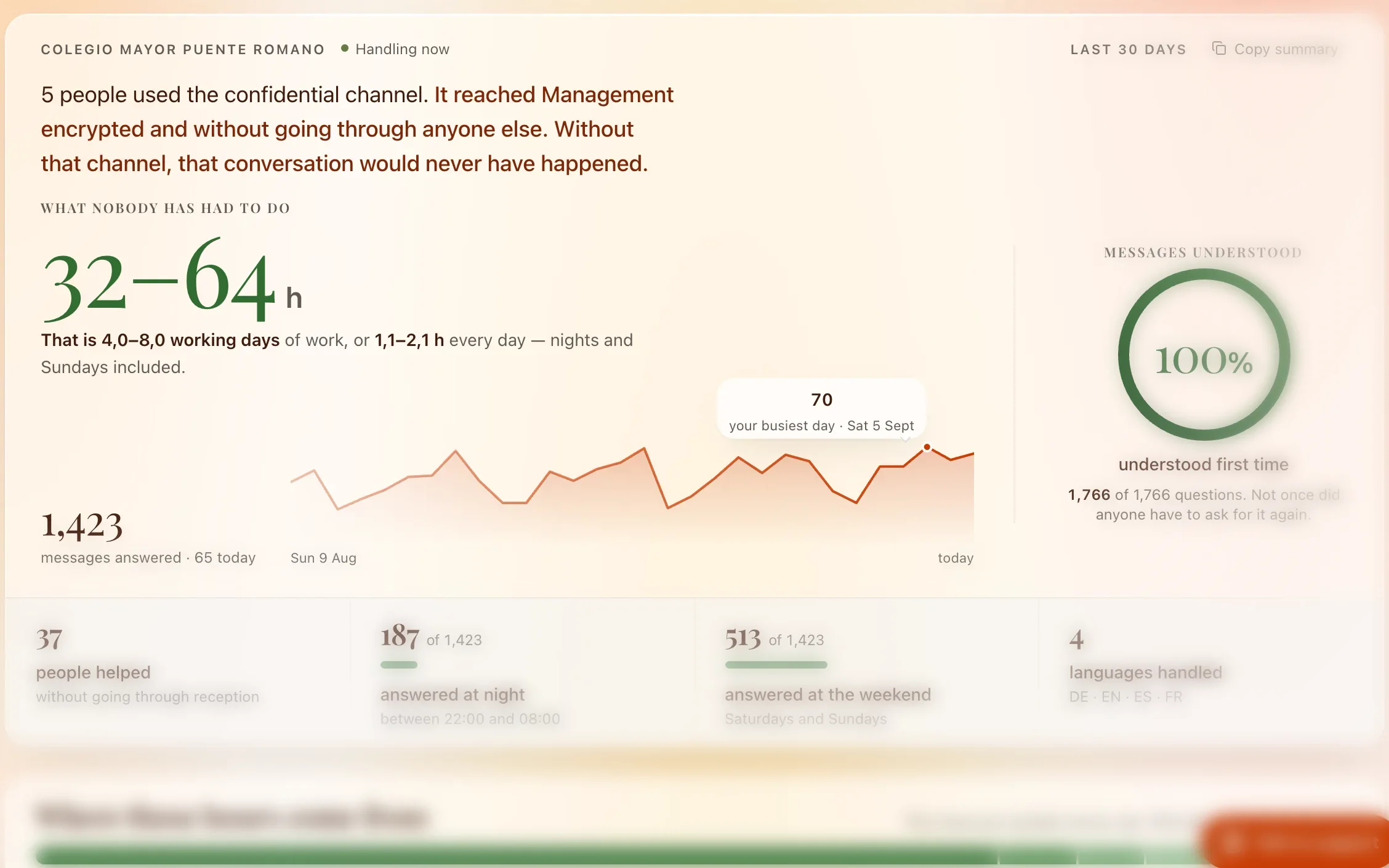
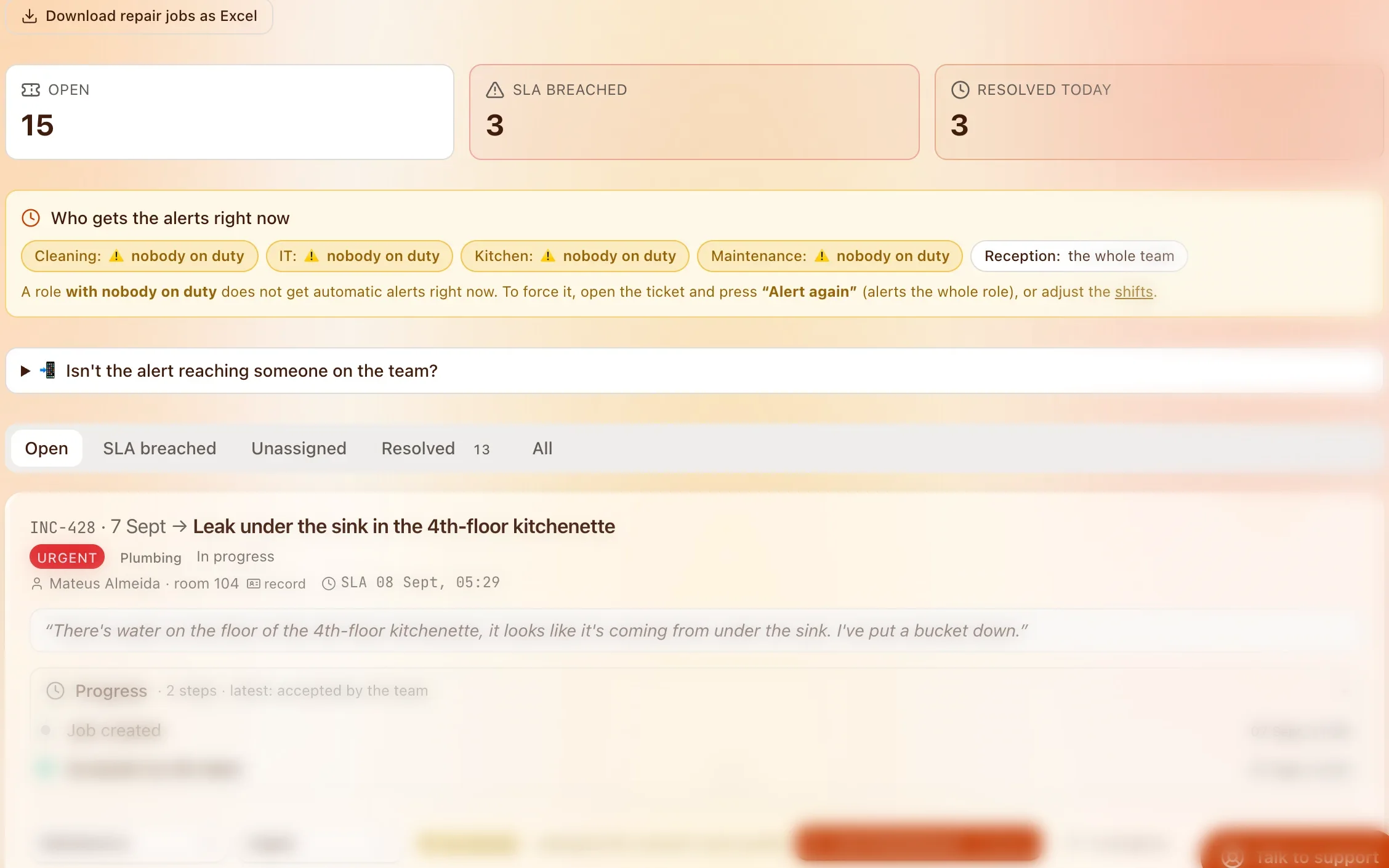
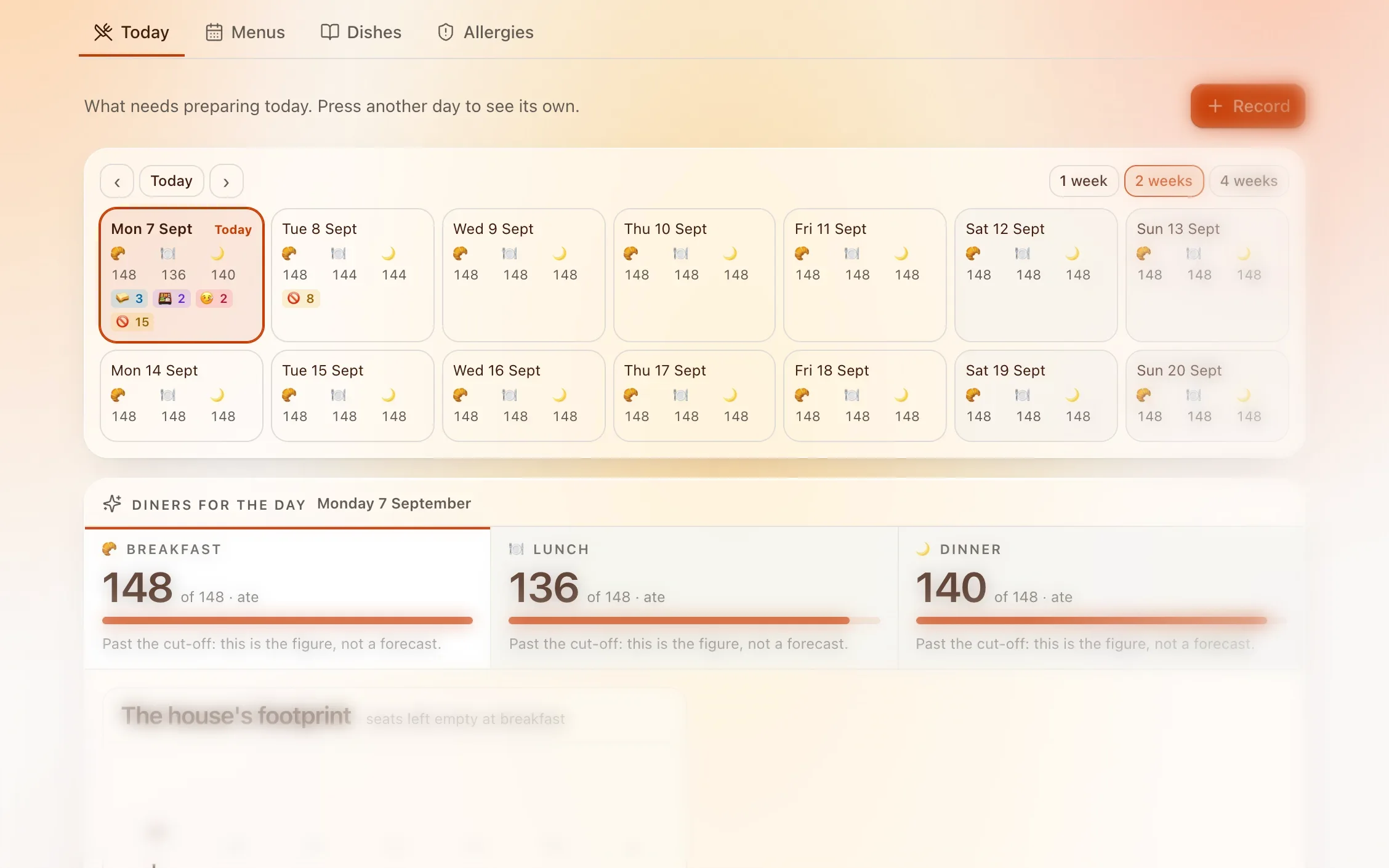
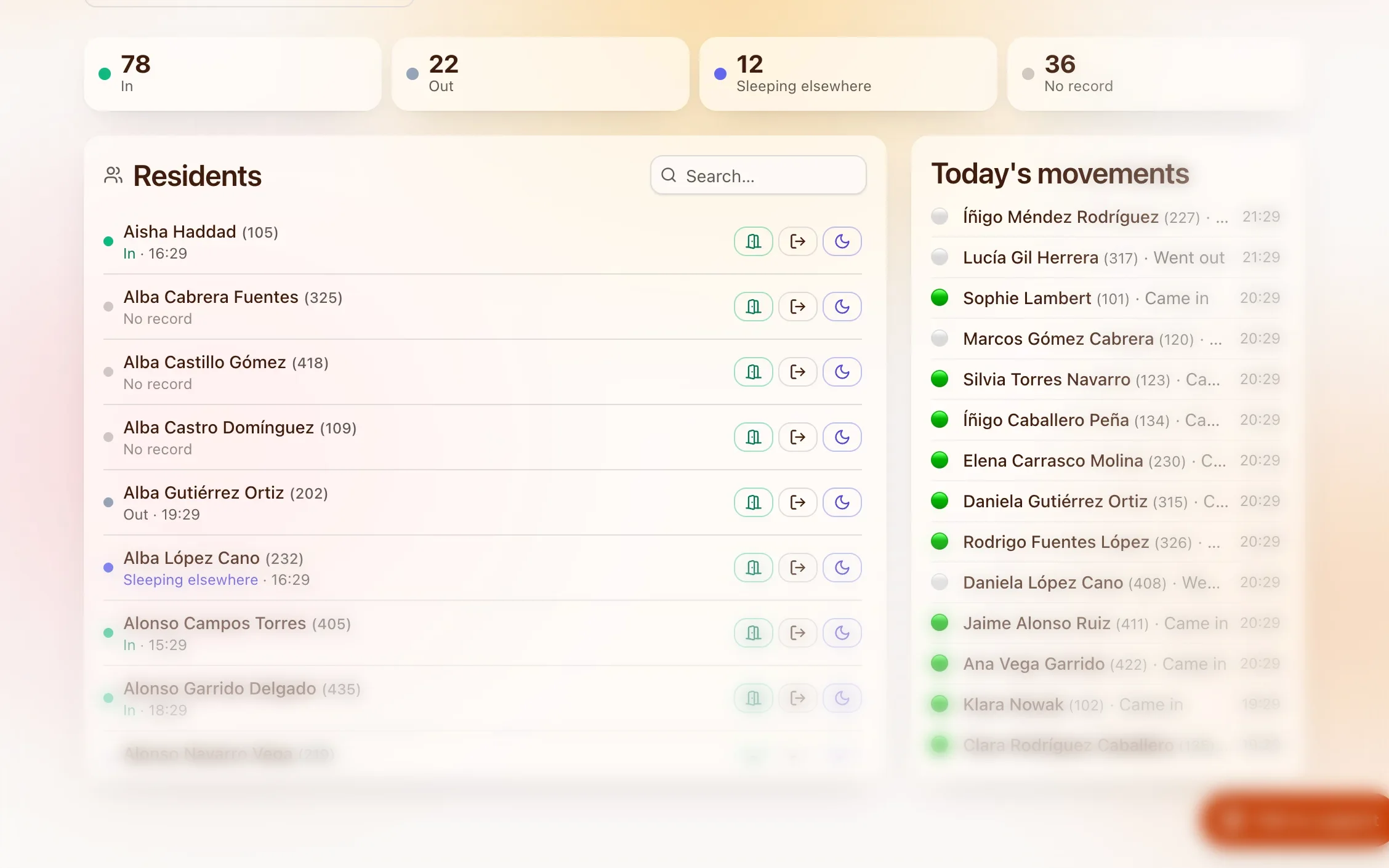
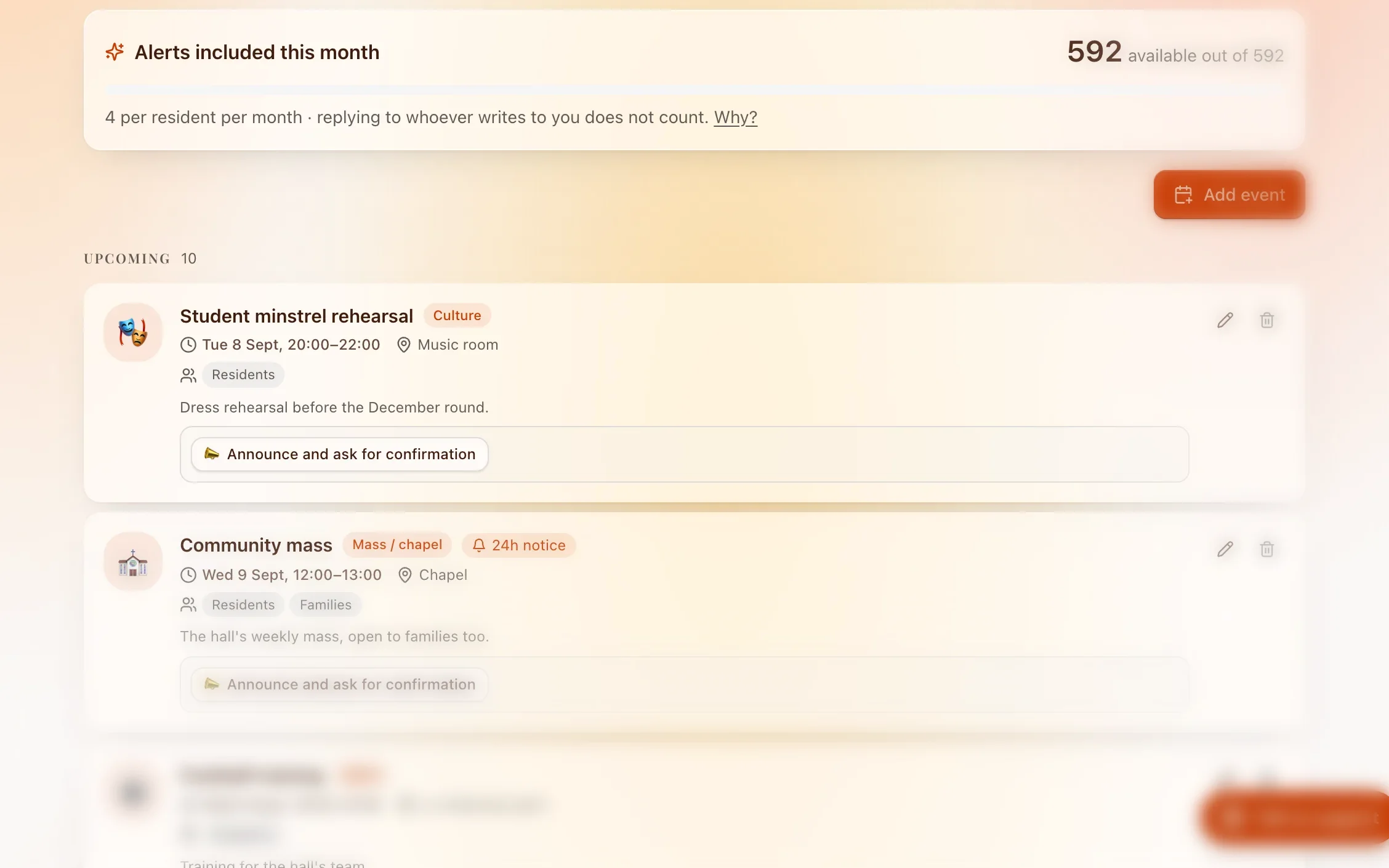
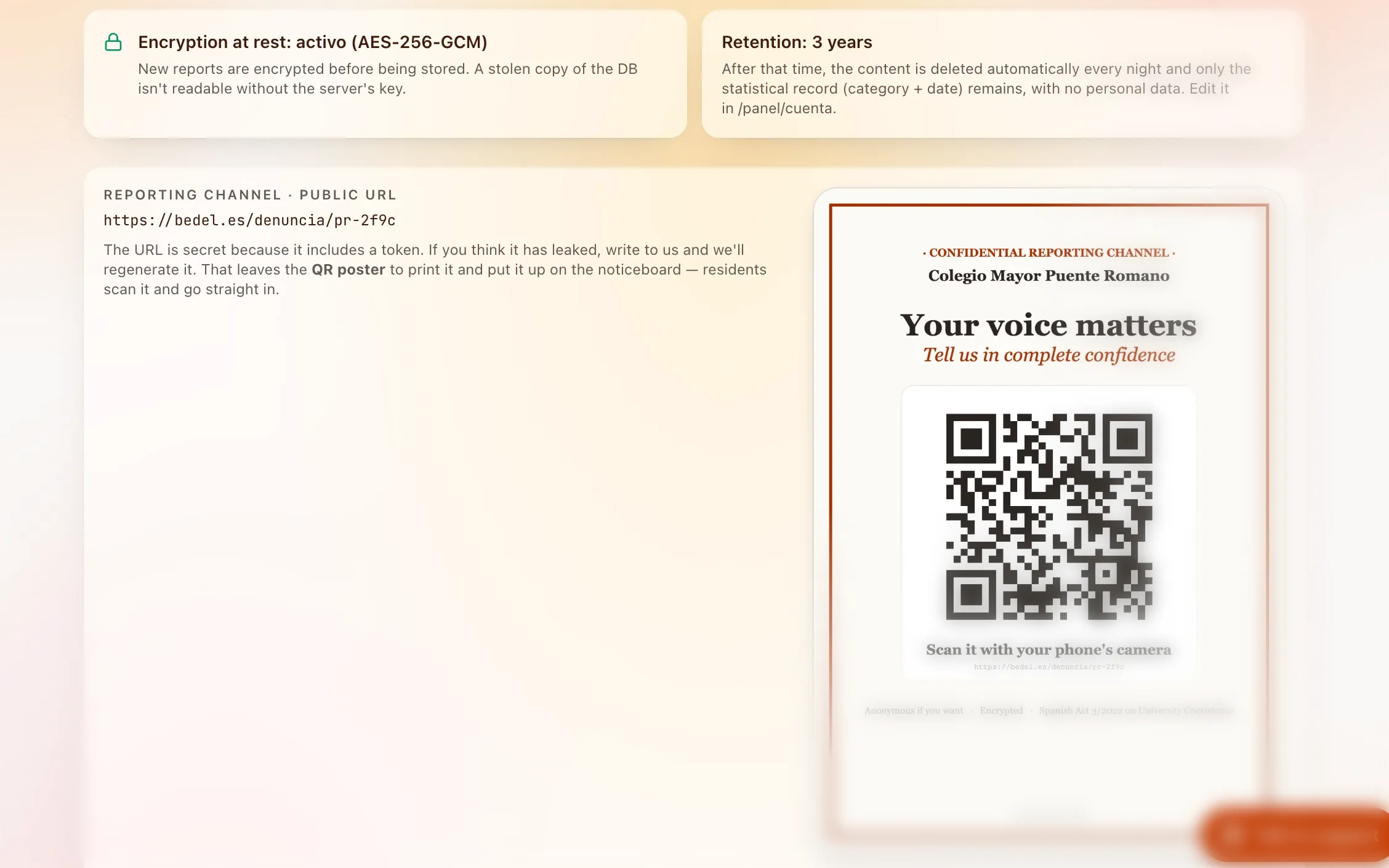
And 17 more screens that don't fit here
- Control room
- Team alerts
- Front desk · parcels
- Spaces and bookings
- Admissions and places
- Information requests in Excel
- The centre's house rules and FAQ
- Parents and families
- Shifts and on-call
- Absences and delegations
- Announcements to the whole centre
- Centre metrics
- Per-resident metrics
- Team performance
- Users and permissions
- The centre's own WhatsApp
- Test sandbox
Real screenshots of the dashboard, with invented data.
Six things that change from the first arrival.
No app for a one-month stay.
Someone staying a few weeks installs nothing: they write to the residence's WhatsApp.
Arrival day, whenever the plane lands.
The wifi, the laundry, the bins: it answers from what you have written down. What isn't written down, it doesn't make up.
Cleaning knows where not to go in.
"Don't clean tomorrow, I'm working from home" reaches the phone of whoever cleans, in-house or contracted.
The delivery arrives and the researcher knows.
Reception logs it with /paquete and the resident gets the notice, even if they haven't written for days.
How long the outside contractor takes.
A dashboard over 7, 30 and 90 days showing who picks up each request and how fast, the contracted technician included.
The repairs log, with no typing.
Everything goes to Excel, and every night the day's summary lands in the inbox of whoever runs the residence.
Two centres already live this way.
62–115 h
of estimated work the team did not have to do · 19 days, two residences.
47 %
of what residents write arrives outside 9am–6pm · 452 of 957.
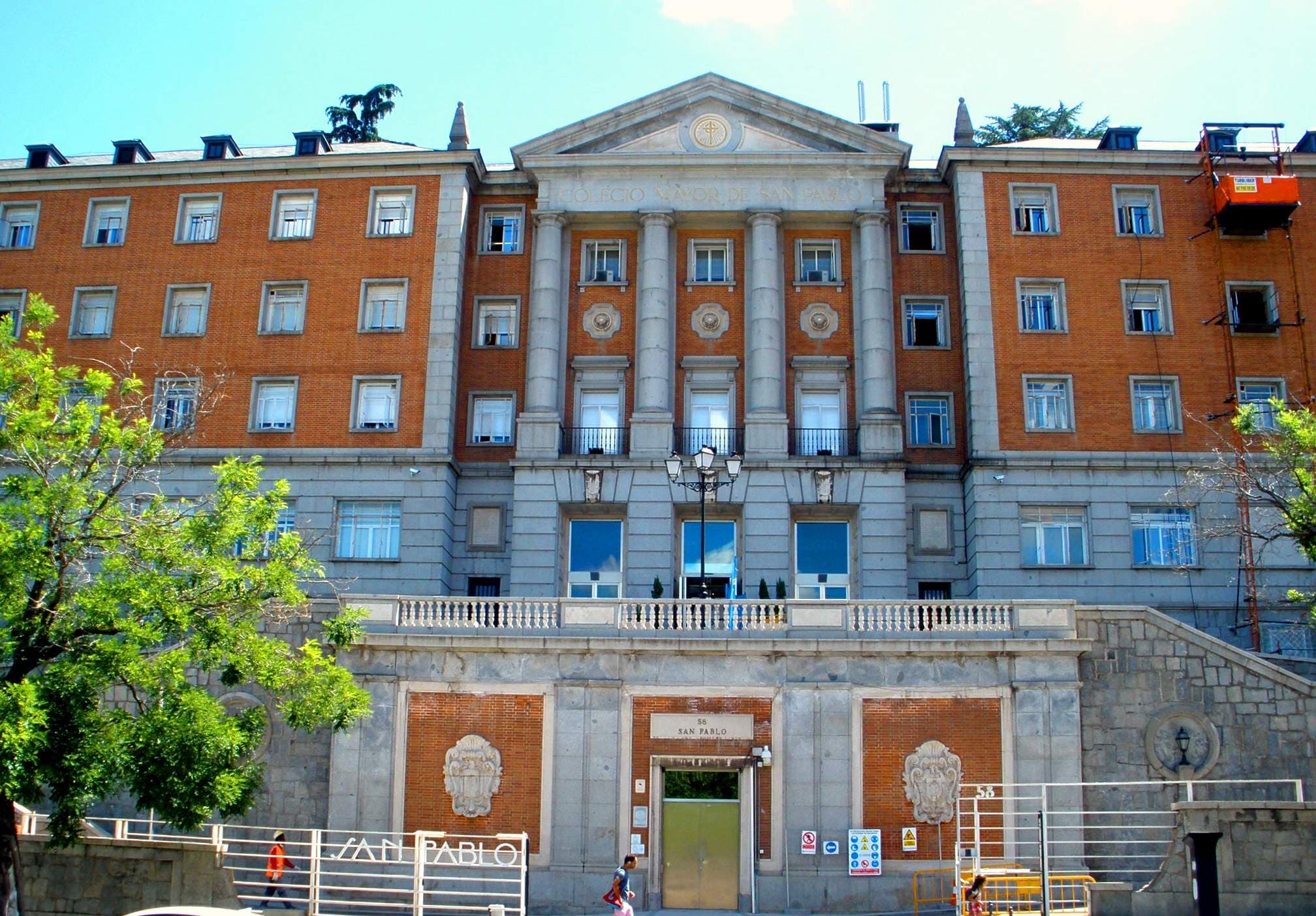 Madrid · Since 1944Colegio Mayor Universitario de San Pablo
89 of 89
residents have written to the channel. Nothing to install.
 ValenciaResidencia Universitaria Anunciata

Two operating residences —a student residence and a hall of residence— added together, from 1 to 19 September 2026. It does not count what the centre's own team writes. A reply is a message from Bedel to someone who has just written (under 10 minutes); automated notices don't count. Office hours: Monday to Friday, 9am to 6pm. Hours are estimated with minutes per task (answering, 1–2 min; opening a repair, 4–8 min), with no rounding up, and come to 7.9–14.4 working days of 8 hours. The 89 residents are those of the student residence, since 1 August.
No surprises. Always at hand.
Secure and compliant
What you will be asked about, already solved.
- The confidential reporting channel you are required to haveSpanish Act 3/2022
- Data in the EU, and deletion that actually deletesGDPR
- We flag what you believe is covered and isn'tFalse coverage
- Meta Tech ProviderWhatsApp Business Platform · authorised directly by Meta, with no resellers or intermediaries in between
Always at hand
Real people, in Spain.
or message us on WhatsApp · call us on +34 681 676 697
Shall we talk for 30 minutes?
We'll show you in a demo, with your researcher residence inside.
- You pick a time that suits you
- We show it to you with a case like yours, in 30 minutes
- If it fits, we leave it running on your WhatsApp
or message us on WhatsApp · call us on +34 681 676 697
Pick a slot and you're done.
For researcher, graduate and visiting-faculty residences
The researcher residence answers every arrival, in their language and at their hour
A Thursday in February, 23:05. A postdoctoral researcher has just arrived from Seoul with two suitcases and writes in English that she cannot find the wifi password. At the same time, a visiting professor asks in French whether his wife and daughter can spend the weekend with him, and the PhD student in 3B sends a photo of an oven that will not heat up. There is nobody in the office until nine: the in-house team is two people, maintenance is run by one company and cleaning by another. Bedel answers that WhatsApp: it gives the password in English if it is in your handbook, leaves the visit question to whoever decides if the house rules do not settle it, and opens the oven ticket for the company's technician, with its deadline.
What it is and what it is not. Bedel is support and communication software for the day-to-day of a residence for researchers, graduate students or visiting faculty. It is not the institution's booking or billing system: it does not allocate apartments, sign contracts, issue certificates of stay or open doors. It answers the building's WhatsApp and puts each thing on the phone of whoever handles it: maintenance, cleaning, reception or the person who manages stays.
What a guest writes, and what Bedel does with each message
- What the researcher or the team writes: "Just landed. What's the wifi password?" at 23:05
- What Bedel does: Answers in English with what the residence has written in its handbook, without waking anyone. If the password is not written down, it does not make it up: the question goes to a person on the relevant shift
- What the researcher or the team writes: A photo of an oven that will not heat up, from 3B
- What Bedel does: Opens a maintenance ticket with its category and deadline and sends it to the maintenance post, even when that post is a company technician with their own WhatsApp. If the oven in 3B was already fixed in the last twelve months, for another tenant, the technician sees it flagged as repeated
- What the researcher or the team writes: "Ma femme et ma fille arrivent samedi, elles peuvent rester ?"
- What Bedel does: Answers in French with what your house rules say about visitors and companions. If the rules do not settle it, it does not decide: it puts it on the phone of the right person according to the org chart, with the conversation in front of them
- What the researcher or the team writes: "Please don't clean my studio tomorrow, I'm working from home"
- What Bedel does: Notes that the studio is not to be cleaned tomorrow and notifies the cleaning post, in-house or contracted; whoever cleans can also check it with /limpieza from their WhatsApp. Urgent cleaning and "come back later" follow the same path
- What the researcher or the team writes: "I need a certificate of accommodation for my visa"
- What Bedel does: It does not draft it or promise it. It passes the request to a person on the team with the conversation: a document that carries a signature is not written by an AI
- What the researcher or the team writes: Reception writes "/paquete para el 4A"
- What Bedel does: Logs the delivery under the name of whoever lives in 4A and notifies them on WhatsApp even if they have not written to the residence for days. More in parcels
- What the researcher or the team writes: "Do you have a studio from 3 March to 30 June?", from a number that is not the residence's
- What Bedel does: Replies with the message the residence left written for people asking about a place, translated into their language, and puts them on the dashboard list with a status. Which studio is free on those dates is not something Bedel knows: the team says so
- What the researcher or the team writes: "I'm away Monday to Thursday at a conference"
- What Bedel does: Logs the three nights away in the absence log; on Thursday morning it asks "Arriving today?" with two buttons
Arrivals any week of the year, not one September
A researcher residence has no move-in day. There is a PhD student who arrives on Tuesday, a visiting professor who lands on Sunday night and a whole project team that moves in on the 1st. Each of them brings the same questions, and until now the team answered them in each person's language or did not answer them at all, depending on when the flight landed. Bedel answers them with what the residence has written once, in Spanish, and only passes to a person what is not written down.
- Whoever arrives is added to the directory with their mobile number, one by one from the dashboard or with a spreadsheet in the format you already use.
- If they change number (the Spanish SIM card on day two), reception generates a single-use code for them in the dashboard; they send it on WhatsApp from the new number and it is linked to their record.
- A number that is not in the directory gets the general answers from the handbook and can report a fault; anything that belongs to a specific person, such as their parcels, waits until the team confirms who they are.
- The year's room rack, with a different arrival and departure date on every row, is uploaded as it is: more in arrivals and room rack.
Many languages on the same corridor
In a house of researchers Spanish is not the common language; at most English is, and not for everyone. Bedel answers in the language of the last message it receives and does not touch what must not change along the way: times, links, figures and names go out exactly as written.
- Six languages are tested: Spanish, English, French, Italian, German and Portuguese. The notice that you are talking to an AI assistant is written in nine.
- If a reply was about to go out in Spanish to someone who does not write in Spanish, a second pass translates it; if that pass fails, the original goes out rather than leaving them with no answer.
- Voice notes are turned into text with the default model, up to 10 MB per note.
- The team keeps working in Spanish: the notices it receives, the handbook it writes and the nightly email, which also counts which languages people wrote in that day.
Maintenance and cleaning contracted out
A researcher residence usually has a small in-house team and two contractors: one that fixes and one that cleans. What hurts is not that they take time, it is that nobody knows how much. Bedel turns every notice into a ticket with a time, an owner and a deadline, and the company's technician works from their WhatsApp, with no login to any program.
- The technician accepts, resolves or reopens with buttons and closes with a photo; the researcher knows when it is accepted and when it is resolved.
- A reminder to whoever owns it at 50 % and 85 % of the deadline; an urgent ticket past its deadline sounds again once a day and after three days goes up to management.
- Faults are compared by apartment and by category, not by person: if the same oven fails again for the next tenant, the technician sees it flagged as repeated. The resident does not.
- Cleaning gets the "not today", the "come back later" and urgent requests on their phone, and checks them with /limpieza. The tickets spreadsheet comes out with the columns of your own log; the company as a supplier and the hours it bills are not recorded.
Who is in, until when, and the day they leave
With stays that run from three weeks to a year, occupancy changes every Monday. Bedel does not handle bookings, but it knows who is sleeping in the building from the rack and from what each person reports, and that is useful twice: for the alarm at three in the morning and for closing every stay properly.
- The absence log records conferences and fieldwork trips; on the day someone is due back, in the morning, it asks "Arriving today?" with two buttons.
- Who is inside right now is worked out from last night, tonight and the day's movements; the evacuation plan is downloaded as a spreadsheet with that list.
- When someone leaves, the residence can execute the right to erasure from their record: their conversations, parcels and presence are deleted, their tickets stay without their name and a record of the request is kept.
- A question about the deposit or the last bill is not answered by an AI with a figure that is not written down: it goes to whoever handles money according to the org chart, and no account number or payment link ever goes out through the chat.
The host institution, its rules and its data
Behind every researcher residence there is a university, a research centre or a foundation, with its international office, its legal department and its data protection officer. What they need is to see without touching, and to know which rules apply to them and which do not.
- Every dashboard user has each section hidden, read-only or with permission to manage: the international office can see conversations and tickets without being able to change anything.
- If the owner is a public university or a public-sector foundation, Spanish Act 2/2023 requires it to have an internal reporting system whatever its headcount (art. 13.1, letters d and f); if it is a private entity, from fifty employees (art. 10.1.a). Bedel's confidential channel is a channel for the building: it does not replace the entity's system or the person responsible for it.
- Housing that a university classifies as university housing and assigns to its enrolled students or to its teaching, administrative and service staff falls outside the Urban Leases Act (art. 5.d); the exclusion refers to staff who depend on that university. Outside that case, how a stay fits in is explained under temporary residential lease.
- The database and the functions live in the European Union (Ireland); the AI model runs in the United States under Standard Contractual Clauses, and the data processing agreement is published.
What Bedel does not do in a researcher residence
- It is not the booking or billing system: it does not know which apartment is free on given dates, it does not allocate, it does not sign contracts and it does not charge.
- It does not issue certificates of accommodation, invitation letters or paperwork for a visa or for registering at the town hall: the request goes to a person on the team.
- The notices it sends on its own (a repair's status, a parcel, "Arriving today?") and the team's announcements go out in Spanish; what gets translated are the replies to what the researcher writes.
- One account is one residence: a university with three residences has three accounts, with no screen that brings them together.
- It does not control keys, locks or access: who is inside comes from what people report and from the rack.
Frequently asked questions
Does it work if researchers arrive on any day of the year?
Yes. Each person is added with their mobile number from the dashboard, one by one or with a spreadsheet, once their stay is confirmed, and from their first message they get answers in their language with what the residence has written down. If they arrive with one number and two days later use another, reception gives them a single-use code that links the new number to their record. There is no intake period to configure: the year's rack takes a different date on every row.
What happens if they write at eleven at night on the day they arrive?
Bedel answers from the residence's handbook: the wifi, how the laundry works, where the bins go, what time the office opens. If something is broken, it opens the ticket; if it is urgent, it notifies the post covering that time according to the org chart, and if it can wait, whoever starts the morning shift receives it. What is not written down, it does not make up: it passes it to a person.
Which languages does it answer in?
In the language of the last message it receives, even if someone switches language mid-conversation. The tested ones are Spanish, English, French, Italian, German and Portuguese. Times, links, figures and names are not translated. The handbook is written once, in Spanish, and what the team writes, such as announcements, goes out exactly as written.
How does it work with an outside maintenance company?
The company's technician goes into the org chart like any other team member, with their mobile number. They receive each ticket with the photo, category and deadline, accept and close it with buttons from their WhatsApp, and get the deadline reminders. If an urgent ticket goes past its deadline, it sounds again every day and after three days goes up to management. The dashboard shows how long they take to pick up and to close, and the tickets spreadsheet is what you bring to the follow-up meeting with the company.
Does Spanish Act 2/2023 require a researcher residence to have a whistleblowing channel?
It depends on who owns it. If it is a public university or a public-sector foundation, yes, whatever its headcount: article 13.1 binds every public-sector entity and names public universities and public-sector foundations. If it is a private entity, only from fifty employees, counted per entity and not per building (art. 10.1.a). In both cases the duty belongs to the entity, not to the residence, and Bedel's confidential channel does not replace its internal system or the person responsible for it.
Can the international office see what happens in the residence?
Yes, with a dashboard user who sees only the sections that concern them and in read-only mode, for example conversations and tickets, without being able to change anything. If they also hold a post in the org chart, whatever the org chart assigns to them reaches their phone. What there is not is a view that brings together several residences of the same institution: each account is one residence.
What happens to the data when the stay ends?
The residence executes the right to erasure from the dashboard when it is asked to or when its retention policy says so: that person's conversations, parcels and presence are deleted, their tickets stay without their name and a record of the request is kept. The database lives in the European Union, and the data processing agreement is published for the institution's data protection officer to review.